


Asking ChatGPT to write your resume produces a document that sounds impressive and says nothing checkable. It invents metrics, quietly promotes you, and sands down the specifics a hiring manager is scanning for.
Pointed at a narrower job it earns its place: reading the posting properly, working out which parts of your real experience matter for it, and helping you phrase evidence you already have. That is the approach this guide takes.
The key isn’t asking ChatGPT to “write my resume.” A better approach is to use AI to understand the job, identify the skills that matter, organize your real experience, and turn your evidence into clear resume bullets.
This guide shows you how to use ChatGPT to build a job winning resume for almost any role while keeping your resume accurate, believable, and tailored to the position.
The process is simple:
Understand the job → Add real proof → Check the match → Speed up applications → Track follow-ups → Review before applying.
Why AI Resumes Fail
AI isn’t necessarily the problem. The shortcut approach is.
Many candidates give ChatGPT a generic instruction such as:
“Write me a professional resume for a marketing job.”
The result may sound polished, but polished language alone doesn’t make a strong resume.
A good resume needs to show a clear connection between what an employer needs and what you have actually done.
Common problems with AI-generated resumes include:
- Generic descriptions
- Unclear achievements
- Too many buzzwords
- Missing job-specific keywords
- Skills without evidence
- Invented responsibilities
- Exaggerated results
- Irrelevant experience
- Poor role alignment
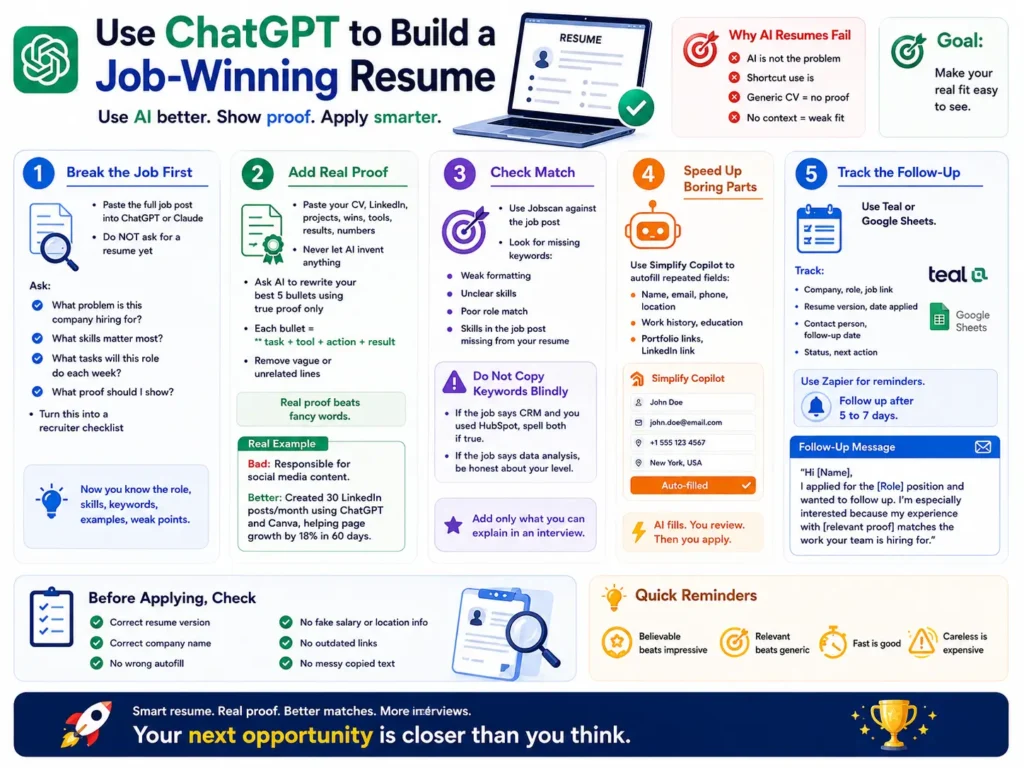
The goal when you use ChatGPT to build a job winning resume should be simple: make your real fit easy for a recruiter to understand.
Believable beats impressive. Relevant beats generic.
1. Break the Job Down Before Writing Your Resume
The first mistake many people make is asking ChatGPT to create a resume immediately.
Don’t start there.
Start with the job description.
Copy the complete job posting into ChatGPT and ask it to analyze the position before creating any resume content.
You can ask:
- What problem is this company hiring for?
- What are the most important skills for this role?
- What responsibilities will this person likely handle each week?
- Which qualifications appear most important?
- What keywords should a relevant resume naturally address?
- What evidence would demonstrate that a candidate can perform this job?
- Which requirements are essential versus desirable?
Then ask ChatGPT to turn the analysis into a simple recruiter checklist.
Example Prompt
Analyze this job description before writing anything. Identify the company’s likely hiring need, the five most important skills, key responsibilities, important keywords, required qualifications, and types of proof a strong candidate should demonstrate. Do not create a resume yet. Present the findings as a recruiter checklist.
This first step gives you a much clearer understanding of the role.
You now have:
- The problem the employer is trying to solve
- Important skills
- Relevant responsibilities
- Useful keywords
- Examples of evidence to show
- Potential gaps in your experience
Only after this analysis should you move to your own background.
2. Add Real Proof From Your Experience
This is where your resume becomes much stronger.
Give ChatGPT your actual information.
You can provide:
- Your current resume
- LinkedIn profile information
- Previous work experience
- University projects
- Freelance projects
- Internships
- Certifications
- Tools you use
- Awards
- Achievements
- Business results
- Portfolio projects
- Relevant numbers
Most importantly, never let AI invent experience you don’t have.
If you didn’t use a particular technology, don’t add it simply because it appears in the job description.
If you didn’t achieve a specific result, don’t allow ChatGPT to create a percentage or statistic.
Your resume should represent your actual experience.
Turn Responsibilities Into Evidence
A weak resume bullet often describes a responsibility.
Bad:
Responsible for social media content.
This tells the employer what you were assigned to do, but not what you actually accomplished.
A stronger version includes the task, tool, action, and result.
Better:
Created 30 LinkedIn posts per month using ChatGPT and Canva, helping page growth increase by 18% in 60 days.
The important difference is evidence.
The second statement gives the reader a clearer picture of:
- What you did
- What tools you used
- How much work you produced
- What result followed
A useful structure is:
Task + Tool + Action + Result
Not every bullet needs all four elements, but this structure can help you transform vague responsibilities into stronger evidence.
If your experience section is genuinely thin, this is what a portfolio project is for. It gives you something concrete to describe rather than something to phrase carefully.
3. Use ChatGPT to Match Your Experience to the Job
Once ChatGPT understands the job and your background, ask it to compare the two.
This is where you can use ChatGPT to build a job winning resume without blindly copying the job description.
Ask ChatGPT to create a comparison such as:
| Job Requirement | Your Evidence | Match | Resume Action |
|---|---|---|---|
| SEO experience | Managed SEO projects | Strong | Highlight project results |
| Analytics | Used Google Analytics | Strong | Add relevant tools |
| Content strategy | Created content plans | Strong | Add achievement |
| CRM | Limited experience | Partial | Be accurate about level |
| Team leadership | Led project team | Strong | Include leadership example |
This comparison helps you identify what deserves more attention in your resume.
It also prevents you from treating every requirement equally.
Some skills will be highly relevant. Others may be minor.
Your resume should reflect that difference.
4. Don’t Copy Keywords Blindly
Keywords matter, but keyword stuffing can make a resume less credible.
Suppose a job description asks for CRM experience and you have genuinely used HubSpot.
You can mention both where appropriate:
CRM: HubSpot
If the job description says “data analysis” and you have only basic experience, don’t suddenly describe yourself as an advanced data analyst.
Instead, accurately describe your level and experience.
The rule is simple:
Only add keywords you can explain confidently in an interview.
A recruiter may appreciate seeing a relevant keyword, but an interviewer can quickly discover whether you actually understand it.
Use AI to identify relevant terminology, not to manufacture qualifications.
5. Create the Resume With ChatGPT
Now that you’ve analyzed the job and collected your evidence, you can ask ChatGPT to create a tailored resume.
Give it clear instructions.
Example Prompt
Create a tailored resume for this job using only the information I provide. Do not invent achievements, responsibilities, companies, technologies, certifications, dates, or metrics. Prioritize experience that directly matches the job description. Rewrite weak bullets using clear action verbs and measurable results where those results are provided. Keep the language professional, concise, and natural. Do not add keywords unless my experience supports them.
Then provide:
- Your existing resume
- The job description
- Your additional achievements
- Relevant projects
- Tools and technologies
- Certifications
- Portfolio information
This gives ChatGPT enough context to produce a more targeted first draft.
Everything in this workflow runs inside ChatGPT itself, with no extra tooling.
6. Make Every Resume Version Role Specific
One resume does not always need to be sent to every employer.
A better approach is to maintain a strong master resume containing your complete experience and then create tailored versions for specific roles.
For example, if you are applying for:
- Digital Marketing Specialist
- SEO Executive
- Content Writer
- Social Media Manager
- Marketing Analyst
The same experience may be relevant to all five positions, but different achievements should receive more attention.
For an SEO position, emphasize:
- SEO campaigns
- Keyword research
- Search optimization
- Analytics
- Technical SEO
- Content optimization
For a social media position, emphasize:
- Content creation
- Social strategy
- Audience growth
- Campaign management
- Engagement
- Visual content
This is one of the biggest advantages when you use ChatGPT to build a job winning resume: you can quickly reorganize your genuine experience around the requirements of each position.
Sabir’s take
The test I apply to anything AI adds to a resume is whether I could answer a follow-up question about it in an interview. If a bullet claims a percentage improvement, I need to know where that number came from. As a translator for work you genuinely did, this is excellent. As a generator, it produces something that collapses the moment anyone probes it.
Frequently Asked Questions About Using ChatGPT for Resumes
Can ChatGPT create a resume for any job?
ChatGPT can help create and tailor resume content for many different roles, provided you give it accurate information about your experience and the target position. You should always review the final result for accuracy.
Is it okay to use ChatGPT for a job application?
Yes. Using AI as a writing and editing assistant can help organize information and improve clarity. The important part is ensuring the final resume accurately represents your own skills, experience, and achievements.
Should I copy the job description into ChatGPT?
Providing the job description can help ChatGPT understand the role and identify relevant requirements. However, you should not blindly copy its keywords into your resume. Only include skills and terminology supported by your actual experience.
Can ChatGPT invent information on my resume?
Yes, AI can generate unsupported details if your prompt doesn’t clearly restrict it. Tell ChatGPT to use only the information you provide and never invent achievements, metrics, technologies, certifications, responsibilities, or experience.
Keeping It Honest
Everything ChatGPT adds has to survive a follow-up question in an interview. If a bullet point claims a percentage improvement, you need to be able to say where the number came from.
The strongest use here is translation rather than invention: taking something you genuinely did and phrasing it in the language the posting uses. Anything past that becomes a liability the moment somebody asks about it.
A resume is half a job search. Finding roles before they are advertised changes what you apply into, and a portfolio project gives thin experience something concrete to describe.