




Microsoft’s agentic AI material is scattered across Learn paths, GitHub repositories, Azure documentation and Foundry, and none of it tells a beginner where to start. Several of the most useful pieces sit buried inside documentation for something else entirely.
The twelve resources below are ordered from fundamentals through to enterprise deployment, with a note on what each one assumes you already know.
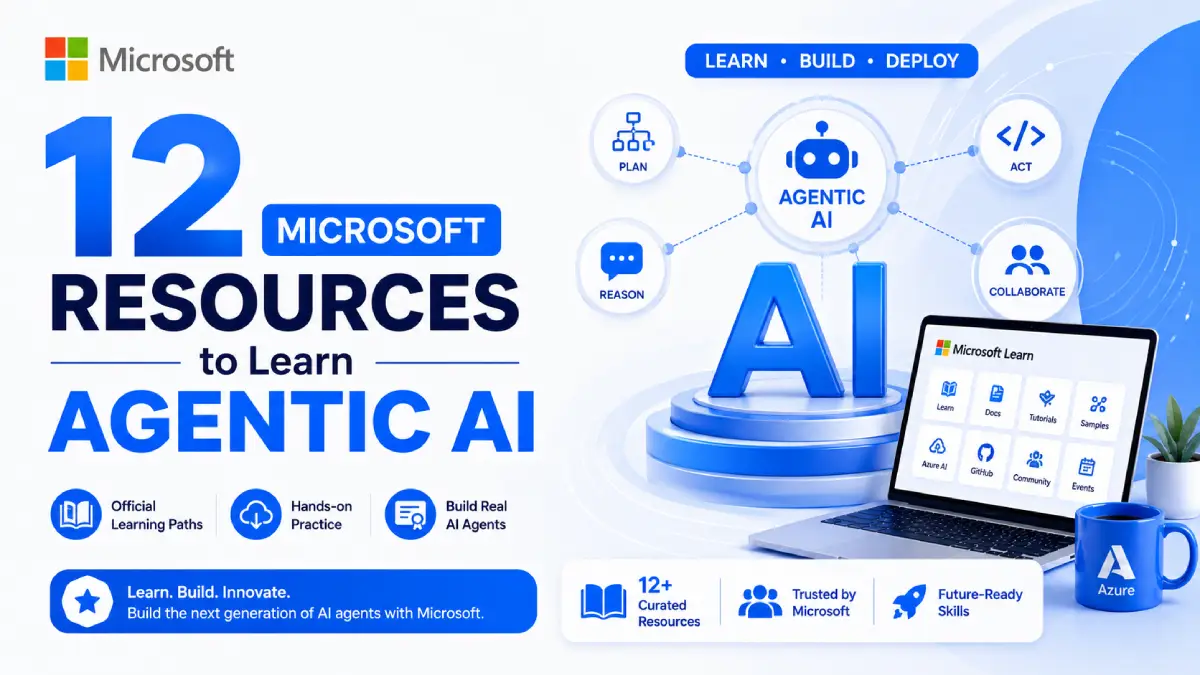
Microsoft has built a broad learning ecosystem covering the journey from agent fundamentals to enterprise deployment. These 12 Microsoft resources to learn Agentic AI can help you move from basic concepts to building, integrating, testing, and deploying AI agents.
Whether you’re a beginner, developer, AI engineer, student, or business professional, these resources provide a practical path for learning Agentic AI with Microsoft technologies.
Why Learn Agentic AI Through Microsoft Resources?
Learning through one connected technology ecosystem can make Agentic AI easier to understand. Microsoft’s resources cover low-code and pro-code development, Azure services, Microsoft Foundry, Copilot Studio, Agent Framework, Model Context Protocol, retrieval, integrations, and enterprise deployment.
The Microsoft resources to learn Agentic AI covered in this guide can be viewed as a progression:
- Understand agent fundamentals.
- Explore the Microsoft agent ecosystem.
- Build your first agents.
- Learn tools and external integrations.
- Understand frameworks and runtime concepts.
- Explore retrieval and enterprise workflows.
- Learn deployment and production concepts.
You don’t need to study all 12 resources at once. Choose the path that matches your experience and learning goal.
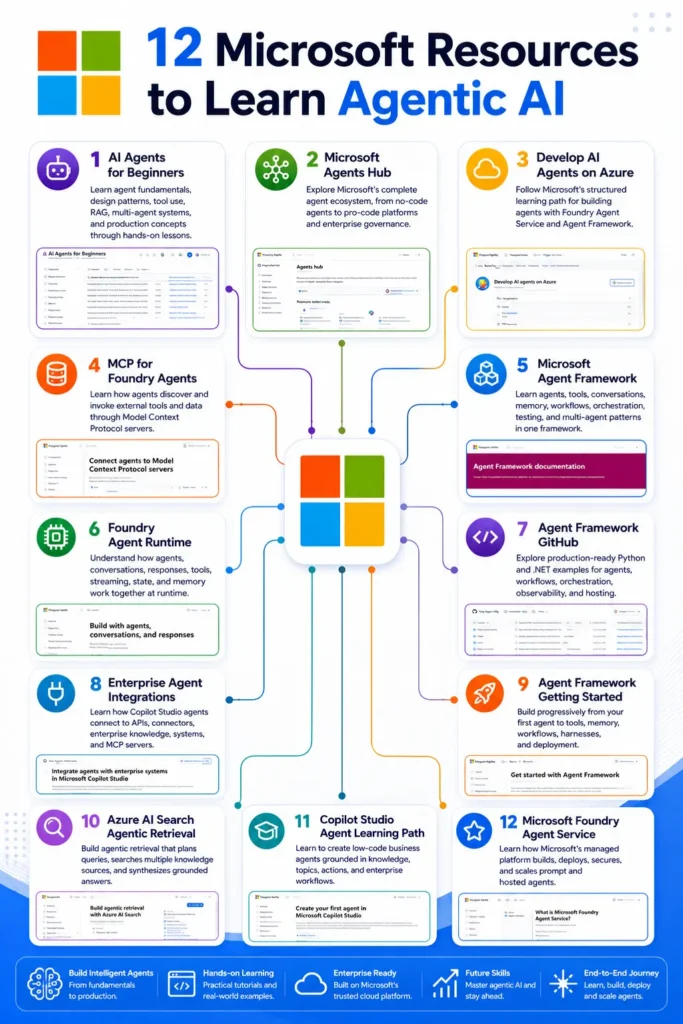
1. AI Agents for Beginners
If you’re new to AI agents, AI Agents for Beginners is a logical place to start.
It introduces agent fundamentals, design patterns, tool use, retrieval-augmented generation, multi-agent systems, and production concepts through hands-on lessons.
It’s particularly useful if you understand basic AI or programming concepts but want to learn how agent-based applications are designed.
Key areas include:
- Agent fundamentals
- Agent design patterns
- Tool calling
- RAG
- Multi-agent systems
- Production concepts
This is one of the most accessible Microsoft resources to learn Agentic AI because it establishes concepts you’ll encounter throughout the rest of the ecosystem.
2. Microsoft Agents Hub
The Microsoft Agents Hub provides a broader overview of Microsoft’s agent ecosystem.
Rather than focusing on one tutorial, it helps you understand different approaches to creating AI agents, from no-code solutions to pro-code platforms and enterprise governance.
Use this resource when you want to understand where Microsoft’s various agent technologies fit together.
It’s especially useful for deciding whether a project needs a low-code business solution, developer-focused framework, or enterprise-grade platform.
3. Develop AI Agents on Azure
The Develop AI Agents on Azure learning path provides a structured route for developers who want to build agents using Microsoft Azure technologies.
It focuses on developing agents with Foundry Agent Service and Agent Framework, connecting theoretical concepts with practical development.
This is a useful next step after learning the fundamentals.
You can use it to understand how an agent moves from an idea into an application capable of using tools, interacting with information, and operating within a cloud environment.
4. MCP for Foundry Agents
Modern AI agents often need access to external tools and information. MCP for Foundry Agents introduces Model Context Protocol and explains how agents can discover and invoke external tools and data through MCP servers.
This is important because an AI model alone may not have access to the systems required to complete a real-world task.
An agent might need to:
- Query a database
- Call an API
- Access a business application
- Retrieve external information
- Execute an approved tool
Understanding MCP helps developers think about agents as systems that can interact with capabilities beyond the underlying model.
5. Microsoft Agent Framework
The Microsoft Agent Framework brings together many of the concepts developers need when building agent applications.
Its learning scope includes:
- Agents
- Tools
- Conversations
- Memory
- Workflows
- Orchestration
- Hosting
- Multi-agent patterns
This makes it useful once you understand basic agent concepts and want to explore application architecture.
If your goal is to build sophisticated workflows rather than simple chatbot experiences, this resource should be an important part of your learning path.
6. Foundry Agent Runtime
Building an agent is only part of the challenge. Developers also need to understand what happens when the agent actually runs.
Foundry Agent Runtime covers concepts such as agents, conversations, responses, tools, streaming, state, and memory working together during execution.
This gives developers a better understanding of the operational side of an agent application.
Instead of thinking only about prompts, you begin considering how conversations, state, tools, memory, and responses interact at runtime.
7. Agent Framework GitHub
The Agent Framework GitHub repository is valuable for developers who prefer learning from working code.
It provides Python and .NET examples involving agent workflows, orchestration, observability, and hosting.
Code examples can answer practical questions that conceptual documentation sometimes cannot.
You can examine how agents are initialized, how tools are connected, how workflows are structured, and how applications are prepared for deployment.
For developers, this is one of the most practical Microsoft resources to learn Agentic AI.
8. Enterprise Agent Integrations
An experimental agent is very different from an agent operating inside a business.
Enterprise Agent Integrations focuses on connecting agents with APIs, connectors, enterprise knowledge, business systems, and MCP servers.
These integrations matter because enterprise agents often need controlled access to information and actions.
For example, an internal business agent might need to retrieve company knowledge, interact with an approved business application, or call a specific API.
Learning integration patterns helps you think beyond the agent itself and understand the systems surrounding it.
9. Agent Framework Getting Started
Agent Framework Getting Started provides a progressive introduction to agent development.
It moves from creating your first agent toward concepts such as tools, memory, workflows, harnesses, and deployment.
This makes it useful for developers who prefer learning in stages rather than studying individual concepts separately.
A practical approach is to build something small first, then gradually introduce tools, memory, workflow logic, and deployment.
10. Azure AI Search Agentic Retrieval
Agents are often only as useful as the information they can access.
Azure AI Search Agentic Retrieval focuses on agentic retrieval, where the system can plan queries, search multiple knowledge sources, and synthesize grounded answers.
This is particularly relevant for applications that work with large collections of organizational or domain-specific information.
Instead of relying only on the model’s existing knowledge, agentic retrieval allows an application to gather relevant information before generating a response.
It is especially useful for enterprise search, research assistants, knowledge applications, and question-answering systems.
11. Copilot Studio Agent Learning Path
Not every AI agent project requires extensive programming.
The Copilot Studio Agent Learning Path focuses on creating low-code business agents grounded in knowledge, topics, actions, and enterprise workflows.
This makes it useful for:
- Business users
- Analysts
- Automation teams
- Operations professionals
- Teams building internal assistants
If your priority is business process automation rather than deep software development, this resource is worth exploring early.
12. Microsoft Foundry Agent Service
The Microsoft Foundry Agent Service focuses on the managed side of agent development.
It covers how Microsoft’s platform can build, deploy, secure, and scale prompt-based and hosted agents.
This becomes particularly relevant when moving from experimentation toward production.
A production agent needs more than a working prompt. It also needs appropriate deployment, security, management, data access, and operational considerations.
How to Choose the Right Microsoft Resources to Learn Agentic AI
The best learning resource depends on your background and objective.
If You’re a Beginner
Start with:
- AI Agents for Beginners
- Microsoft Agents Hub
- Copilot Studio Agent Learning Path
These resources can help you understand the fundamentals before moving into advanced development.
If You’re a Developer
A strong progression is:
- AI Agents for Beginners
- Develop AI Agents on Azure
- Microsoft Agent Framework
- Agent Framework Getting Started
- Agent Framework GitHub
After that, explore MCP, runtime concepts, retrieval, integrations, and deployment.
If You Work in an Enterprise Team
Prioritize:
- Microsoft Agents Hub
- Enterprise Agent Integrations
- Azure AI Search Agentic Retrieval
- Microsoft Foundry Agent Service
- Copilot Studio Agent Learning Path
This path places greater emphasis on enterprise knowledge, integrations, governance, workflows, and deployment.
Sabir’s take
Microsoft’s material here is thorough and badly signposted. I lost time early on jumping between Learn paths and Foundry documentation that assumed different starting points. Working through these in order matters more than which one you begin with, and I would resist starting at the enterprise end however closely it matches your job title.
Frequently Asked Questions About Microsoft Resources to Learn Agentic AI
What are the best Microsoft resources to learn Agentic AI?
AI Agents for Beginners is a strong starting point for newcomers. Developers can continue with Develop AI Agents on Azure, Microsoft Agent Framework, Agent Framework Getting Started, and the Agent Framework GitHub repository.
Can beginners learn Agentic AI from Microsoft?
Yes. AI Agents for Beginners provides an introduction to agent concepts, while Copilot Studio offers a low-code route for people who want to create business agents without starting with advanced programming.
Do I need programming experience to learn Agentic AI?
Not necessarily. Some Microsoft resources focus on low-code development, while others are designed for Python and .NET developers. Your learning path should match your technical background and goals.
What is MCP in Agentic AI?
Model Context Protocol is a standardized way for AI applications and agents to interact with external tools and data through MCP servers. It can extend what an agent can do beyond the capabilities of its underlying model.
For a broader starting point, the certificate courses cover fundamentals, and the Claude Code walkthrough shows an agentic workflow end to end. Microsoft indexes everything through Microsoft Learn.