




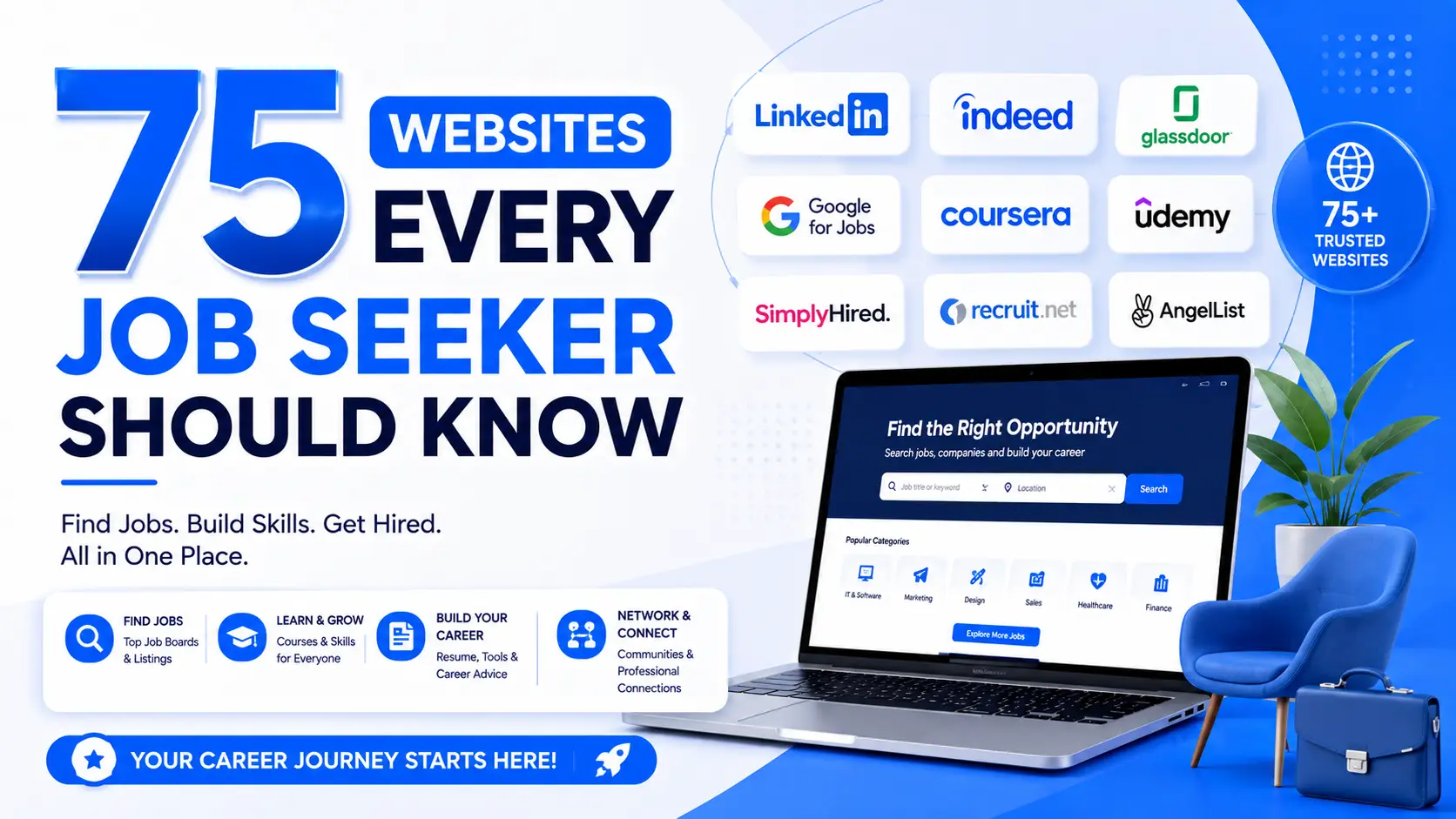
Job boards are not interchangeable. Some carry roles that appear nowhere else, some are aggregators recycling the same listings, and a few reward daily checking while the rest do not.
The sites below are grouped by what each is genuinely good for, including which ones overlap enough that you only need one.
The right online resources can make your job search much easier.
Instead of relying on one job board, successful job seekers can use different websites for finding vacancies, discovering remote work, improving resumes, preparing for interviews, researching salaries, learning new skills, and building professional portfolios.
This guide brings together the job-search sites worth knowing in one practical list. Whether you’re a fresher, experienced professional, freelancer, developer, designer, or someone planning a career change, these platforms can help you move through different stages of the job search process.
1. Job Search Platforms
If you’re actively looking for employment, start with general job boards. These platforms can help you discover opportunities across industries, experience levels, and locations.
| # | Website | Best For |
|---|---|---|
| 1 | LinkedIn Jobs | Professional jobs and networking |
| 2 | Indeed | General job searches |
| 3 | Naukri | Jobs in India |
| 4 | Foundit | Jobs and career opportunities |
| 5 | Glassdoor | Jobs and company information |
| 6 | Wellfound | Startup jobs |
| 7 | Freshersworld | Fresher opportunities |
| 8 | TimesJobs | Professional jobs |
| 9 | Hirrect | Hiring and job opportunities |
| 10 | Internshala | Internships and entry-level jobs |
LinkedIn Jobs, Indeed, Naukri, Foundit, and Glassdoor are particularly useful starting points for broad searches. Freshers and students may also find Internshala and Freshersworld useful for internships and early-career opportunities.
Don’t simply apply to everything you see. Create focused searches based on your skills, location, experience, and preferred job title.
2. Remote Job Platforms
Remote work has created more opportunities for professionals who want location flexibility. Dedicated remote job boards can make it easier to find companies hiring distributed teams.
| # | Website | Best For |
|---|---|---|
| 11 | We Work Remotely | Remote careers |
| 12 | RemoteOK | Remote technology and business jobs |
| 13 | FlexJobs | Flexible and remote work |
| 14 | Remotive | Remote jobs |
| 15 | Working Nomads | Remote professionals |
| 16 | Dynamite Jobs | Remote opportunities |
| 17 | JustRemote | Remote vacancies |
| 18 | Jobspresso | Remote work |
| 19 | Himalayas | Remote careers |
| 20 | Remote.co | Remote jobs and resources |
When applying for remote positions, pay close attention to location restrictions. A job described as remote may still require you to live in a particular country, region, or time zone.
3. Resume and ATS Tools
A strong resume needs to communicate your experience clearly. Many companies also use applicant tracking systems to organize applications.
These tools can help you improve your resume structure, wording, and compatibility with common recruitment workflows.
| # | Website | Best For |
|---|---|---|
| 21 | Jobscan | Resume and job description comparison |
| 22 | ResumeWorded | Resume feedback |
| 23 | Rezi | AI-assisted resumes |
| 24 | Enhancv | Resume design |
| 25 | Kickresume | Resume and cover letter creation |
A useful approach is to customize your resume for the position instead of sending exactly the same document to every employer.
Look at the job description, identify the skills and responsibilities that genuinely match your experience, and describe your relevant achievements clearly.
4. Interview Preparation Websites
Getting an interview is only one part of the process. Preparation can help you communicate your experience and technical knowledge more effectively.
| # | Website | Best For |
|---|---|---|
| 26 | LeetCode | Coding interviews |
| 27 | Interviewing.io | Technical interview practice |
| 28 | Pramp | Practice interviews |
| 29 | Exponent | Product and technical interviews |
| 30 | Big Interview | Interview preparation |
| 31 | Glassdoor Interview Questions | Interview question research |
| 32 | Prepfully | Interview preparation |
| 33 | Yoodli | Communication practice |
| 34 | GeeksforGeeks | Technical preparation |
| 35 | HackerRank | Coding assessments |
Technical candidates can use platforms such as LeetCode, HackerRank, and GeeksforGeeks for coding practice. Candidates preparing for product, business, or communication-focused roles can explore platforms designed around those interview formats.
5. AI Tools for Job Seekers
AI can assist with several parts of a job search, including brainstorming, research, writing, practice, and organizing information.
| # | Website | Best For |
|---|---|---|
| 36 | ChatGPT | Writing and career assistance |
| 37 | Claude | Writing and analysis |
| 38 | Gemini | Research and productivity |
| 39 | Teal HQ | Job search organization |
| 40 | Perplexity | Research and information gathering |
AI should support your job search rather than misrepresent your experience.
For example, you can use AI to improve the clarity of a resume bullet, practice interview questions, or brainstorm questions to ask an interviewer. Always verify important information and make sure applications accurately represent your skills and experience.
For more AI-powered resources, you can explore AIToolsay.
6. Salary Research Websites
How much should you expect to earn?
Salary research platforms can help you understand compensation ranges before accepting an offer or negotiating with an employer.
| # | Website | Best For |
|---|---|---|
| 41 | AmbitionBox | Salary information in India |
| 42 | Glassdoor Salaries | Salary and company research |
| 43 | Levels.fyi | Technology compensation |
| 44 | Payscale | Compensation research |
| 45 | Salary.com | Salary information |
Salary information can vary significantly based on location, experience, skills, company size, industry, and job level.
Use several sources when possible rather than treating one reported figure as a guaranteed salary.
7. Free Learning Platforms
Skills can make a major difference when you’re competing for opportunities.
If a job description repeatedly mentions a skill you need to improve, online learning platforms can help you close that gap.
| # | Website | Best For |
|---|---|---|
| 46 | Coursera | Courses and professional learning |
| 47 | Google Digital Garage | Digital skills |
| 48 | HubSpot Academy | Marketing and business skills |
| 49 | freeCodeCamp | Programming |
| 50 | Great Learning | Professional and technical learning |
You don’t need to collect certificates endlessly. Focus on learning skills that connect directly to the roles you’re targeting.
For example, a developer might prioritize programming and cloud skills, while a digital marketer might focus on SEO, analytics, content marketing, and advertising.
8. Mock Interview Platforms
Reading interview questions is useful, but actually practicing your answers can reveal weaknesses that aren’t obvious when you’re preparing silently.
| # | Website | Best For |
|---|---|---|
| 51 | Pramp | Practice interviews |
| 52 | Interviewing.io | Technical interview practice |
| 53 | Big Interview | Mock interviews |
| 54 | Exponent | Product and technical interviews |
| 55 | Final Round AI | Interview preparation |
Practice answering common questions aloud.
Pay attention to whether your answers are specific, organized, and supported by real examples. For behavioral questions, preparing several experiences from your education or work history can make interviews easier.
9. Portfolio and Project Websites
A resume tells employers what you’ve done. A portfolio can show them.
This is particularly important for developers, designers, writers, marketers, and other professionals whose work can be demonstrated through projects.
| # | Website | Best For |
|---|---|---|
| 56 | GitHub | Software development |
| 57 | Behance | Creative portfolios |
| 58 | Dribbble | Design portfolios |
| 59 | Dev.to | Developer content |
| 60 | CodePen | Front-end projects |
A portfolio doesn’t need dozens of projects.
A few strong, relevant projects can be more useful than a large collection of unfinished work. Explain what you built, what problem you solved, which technologies or skills you used, and what you learned.
10. Career and Growth Resources
Getting hired is important, but career growth continues after your first job.
These websites can support professional development, management skills, business knowledge, and continued learning.
| # | Website | Best For |
|---|---|---|
| 61 | MindTools | Professional development |
| 62 | Coursera Career Hub | Career resources |
| 63 | Harvard Business Review | Business and leadership |
| 64 | Alison | Online learning |
| 65 | edX | Academic and professional learning |
Use these resources to improve skills beyond your immediate job application.
Communication, leadership, problem-solving, project management, and business knowledge can become increasingly valuable as your career progresses.
11. Bonus Websites Every Job Seeker Should Know
The final group includes platforms that can help with startups, company research, specialized opportunities, and international or government careers.
| # | Website | Best For |
|---|---|---|
| 66 | AngelList | Startup opportunities |
| 67 | Crunchbase | Company research |
| 68 | Startup Jobs | Startup careers |
| 69 | Cutshort | Professional jobs |
| 70 | TrueUp | Technology careers |
| 71 | Jobai | Job opportunities |
| 72 | Jobicy | Remote jobs |
| 73 | EU Careers | European Union careers |
| 74 | UN Careers | United Nations opportunities |
| 75 | USAJOBS | U.S. government jobs |
Company research can be especially useful before an interview. Learning about an employer’s products, industry, business model, and recent activities can help you prepare more relevant questions.
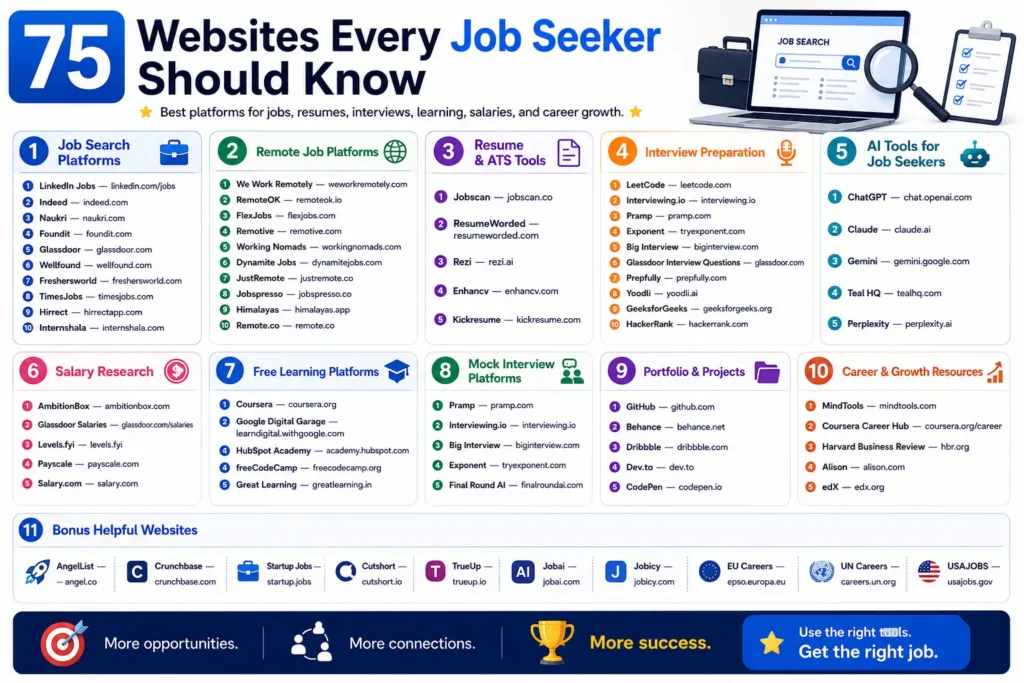
How to Use These Sites
You don’t need to visit every one of these every day.
Instead, create a simple workflow around your current career goal.
If You’re Actively Applying for Jobs
Focus on:
- LinkedIn Jobs
- Indeed
- Naukri
- Foundit
- Glassdoor
- Wellfound
- Relevant industry-specific platforms
Create saved searches and check new opportunities consistently.
If You’re Looking for Remote Work
Start with:
- We Work Remotely
- RemoteOK
- Remotive
- FlexJobs
- Himalayas
- Remote.co
Check eligibility and location requirements before applying.
If Your Resume Needs Improvement
Use:
- Jobscan
- ResumeWorded
- Rezi
- Enhancv
- Kickresume
Then customize your final resume for the actual position.
If You Have an Interview Coming Up
Use:
- LeetCode
- HackerRank
- GeeksforGeeks
- Pramp
- Interviewing.io
- Big Interview
Choose resources based on the type of interview you’re facing.
If You Need Better Skills
Explore:
- Coursera
- freeCodeCamp
- HubSpot Academy
- Google Digital Garage
- edX
- Great Learning
Choose learning based on your target job rather than taking unrelated courses.
Frequently Asked Questions About Websites for Job Seekers
What are the best websites for job seekers?
The best website depends on your goal. LinkedIn Jobs, Indeed, Naukri, Foundit, and Glassdoor are useful for general job searches, while platforms such as RemoteOK and We Work Remotely focus on remote opportunities.
How many job websites should I use?
You don’t need to use all of them. Choose a small group that matches your industry, location, experience level, and career goals. Using several relevant platforms can give you broader coverage without making your search difficult to manage.
Which websites are best for freshers?
Freshers can explore Internshala, Freshersworld, LinkedIn Jobs, Naukri, Indeed, and relevant learning platforms. Building practical projects and improving interview skills can also strengthen an entry-level application.
Which websites are useful for remote jobs?
We Work Remotely, RemoteOK, FlexJobs, Remotive, Working Nomads, Dynamite Jobs, JustRemote, Himalayas, Jobspresso, and Remote.co are among the platforms in this list focused on remote opportunities.
Applying is only half of it: finding roles before they are listed changes the odds, and tailoring the resume matters more than volume. Most of these sites feed from LinkedIn too.