





Most lists of AI skills are lists of tool names, which age badly. The skills below are the ones that survive a model release: how to specify a task properly, when to hand work to an agent, and how to check what comes back.
Each entry says what the skill actually involves and where it is already being hired for.
Artificial Intelligence is no longer limited to developers or data scientists. Marketers, designers, entrepreneurs, students, writers, and business professionals are all using AI to work faster and make smarter decisions. However, simply using ChatGPT is no longer enough. The biggest advantage comes from understanding how modern AI systems work together.
Each entry below covers what the skill actually involves, when it is worth reaching for, and the tools people use to practise it.
Whether you’re starting your AI journey or upgrading your existing knowledge, these skills will prepare you for the next generation of AI-powered work.
Why Learning AI Skills Matters in 2026
AI is becoming part of everyday business operations rather than an optional technology. Companies are using AI to automate repetitive work, improve customer experiences, analyze large amounts of information, and create content faster.
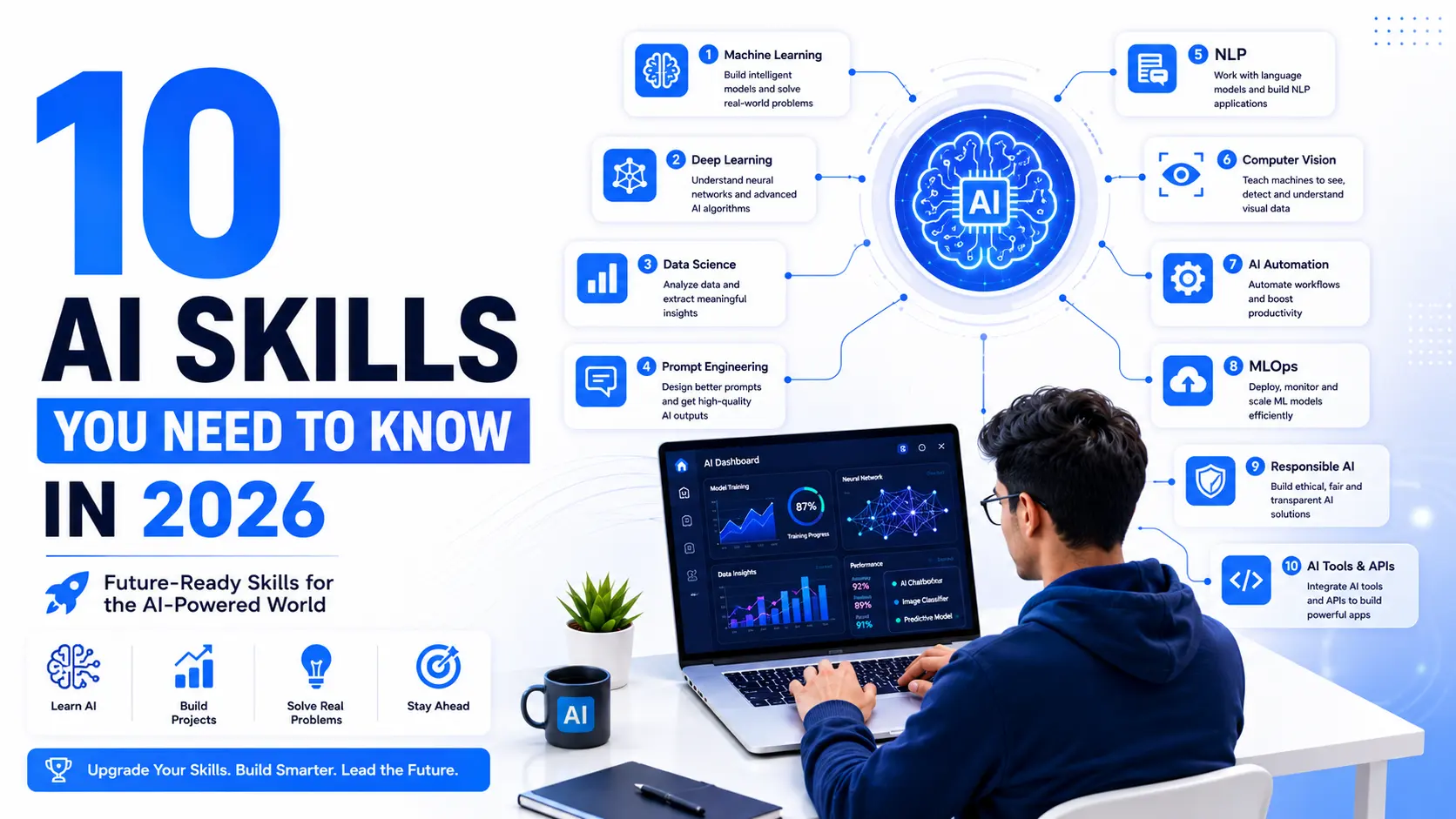
Learning the 10 AI Skills You Need To Know In 2026 can help you:
- Improve productivity
- Save hours every week
- Build valuable career skills
- Automate repetitive work
- Create better content
- Make smarter business decisions
- Stay competitive in the AI-driven job market
The focus is shifting from simply using AI tools to building complete AI-powered workflows.
Overview of the Top 10 AI Skills
| AI Skill | Best Use Case | Difficulty |
|---|---|---|
| Prompt Engineering | Better AI responses | Beginner |
| AI Agents | Task automation | Intermediate |
| Workflow Automation | Business automation | Intermediate |
| Agentic AI | Complex decision-making | Advanced |
| Multimodal AI | Content creation | Beginner |
| RAG | Knowledge-based AI | Advanced |
| AEO / GEO | AI search visibility | Intermediate |
| AI Tool Stacking | Connected AI systems | Intermediate |
| AI Content Generation | Marketing & publishing | Beginner |
| LLM Management | Enterprise AI optimization | Advanced |
1. Prompt Engineering
What is Prompt Engineering?
Prompt Engineering is the skill of communicating with AI effectively. The quality of your prompt often determines whether AI produces an average answer or a professional-quality solution.
Instead of asking AI simple questions, prompt engineering teaches you how to structure instructions, provide context, define roles, and specify expected outputs.
When should you use it?
Use prompt engineering whenever you want AI to think like:
- A strategist
- A consultant
- A software developer
- A marketer
- A researcher
- A business analyst
Popular Tools
- ChatGPT
- Claude
- Gemini
- Perplexity
Practical Example
Instead of asking:
“Write an email.”
Try:
“Write a professional sales email for a SaaS product targeting startup founders. Keep it under 150 words with a strong CTA.”
The difference in quality is significant.
2. AI Agents
What are AI Agents?
AI Agents go beyond answering questions.
Instead of simply generating text, they complete tasks from start to finish with minimal human involvement.
They can:
- Research information
- Generate reports
- Schedule meetings
- Collect leads
- Complete repetitive workflows
When should you use AI Agents?
Use AI Agents for:
- Lead generation
- Market research
- Scheduling
- Customer support
- Data gathering
Popular Tools
- OpenAI Agents
- CrewAI
- LangGraph
- LangChain
AI Agents are expected to become one of the biggest productivity improvements across businesses in 2026.
3. Workflow Automation
What is Workflow Automation?
Workflow automation connects your applications so repetitive tasks happen automatically.
Instead of manually copying information between tools, automation handles it for you.
Common automation examples
- CRM updates
- Employee onboarding
- Form processing
- Email notifications
- Report generation
- Data synchronization
Popular Tools
- Make
- Zapier
- n8n
- Bardeen
Workflow automation saves time while reducing human error.
4. Agentic AI
What is Agentic AI?
Agentic AI is one of the fastest-growing AI concepts.
Unlike traditional AI systems that follow fixed instructions, Agentic AI can:
- Plan
- Adapt
- Make decisions
- Self-correct
- Complete multi-step objectives
This flexibility makes it suitable for solving complex business problems.
When should you use Agentic AI?
Ideal for:
- Research projects
- Business operations
- Quality assurance
- Strategic planning
- Multi-step analysis
Popular Tools
- OpenAI o1
- Claude
- Reflection
- DSPy
5. Multimodal AI
What is Multimodal AI?
Multimodal AI works across different content formats simultaneously.
Instead of only generating text, it understands and creates:
- Images
- Audio
- Video
- Documents
- Code
- Text
Example
A marketer could provide a product idea and receive:
- Blog content
- Social media posts
- Product images
- Video scripts
- Voiceovers
All generated within one workflow.
Popular Tools
- Gemini
- Claude Sonnet
- OpenAI Vision
- Stable Audio
Multimodal AI is transforming creative workflows.
6. Retrieval-Augmented Generation (RAG)
What is RAG?
Retrieval-Augmented Generation (RAG) improves AI accuracy by allowing models to retrieve information from your own data before generating responses.
Instead of relying only on training data, AI searches trusted sources first.
Why is RAG important?
It helps reduce:
- Hallucinations
- Incorrect answers
- Outdated information
Common business use cases
- Customer support
- Internal documentation
- Knowledge bases
- Sales assistance
- Company search systems
Popular Tools
- Pinecone
- LlamaIndex
- Haystack
- Elastic
Organizations increasingly rely on RAG whenever factual accuracy is essential.
7. AEO / GEO (Answer & Generative Engine Optimization)
What is AEO / GEO?
Search behavior is changing.
People increasingly ask AI assistants questions instead of typing keywords into traditional search engines.
AEO (Answer Engine Optimization) and GEO (Generative Engine Optimization) focus on making your content easier for AI systems to understand and reference.
Why does it matter?
Brands that optimize for AI-generated answers improve their chances of appearing in AI responses.
Best use cases
- Business websites
- Blogs
- Product pages
- Knowledge hubs
- Documentation
Popular Tools
- Searchable
- Trakkr.ai
- Screaming Frog
As AI search grows, AEO and GEO are becoming valuable digital marketing skills.
8. AI Tool Stacking
What is AI Tool Stacking?
No single AI application does everything.
AI Tool Stacking combines multiple specialized tools into one connected workflow.
For example:
Idea Generation → Content Writing → Image Creation → Publishing → Analytics
Instead of switching manually between tools, automation connects them into one seamless system.
Popular Tools
- Notion AI
- ClickUp AI
- Airtable AI
- Zapier AI
Tool stacking helps businesses reduce costs while increasing efficiency.
9. AI Content Generation
What is AI Content Generation?
Content creation remains one of AI’s most practical applications.
Modern AI helps teams create:
- Blog articles
- Video scripts
- Podcasts
- Social media posts
- Email campaigns
- Marketing copy
Best use cases
- Daily publishing
- Content repurposing
- Video editing
- Podcast production
- Marketing campaigns
Popular Tools
- Descript
- Saywhat
- OpusClip
- ElevenLabs
AI doesn’t replace creativity—it accelerates production while allowing creators to focus on strategy and quality.
10. LLM Management
What is LLM Management?
As organizations use multiple AI models, managing them becomes increasingly important.
LLM Management focuses on:
- Performance monitoring
- Cost optimization
- Accuracy evaluation
- Security
- Reliability
- Return on investment (ROI)
When should you use it?
Once AI becomes a core part of business operations.
Popular Tools
- Arize AI
- TruLens
- Helicone
- Weights & Biases
Large organizations use LLM management to ensure AI systems remain effective and cost-efficient over time.
Comparison Table of the 10 AI Skills You Need To Know In 2026
| Skill | Primary Goal | Best For |
|---|---|---|
| Prompt Engineering | Better AI responses | Everyone |
| AI Agents | Autonomous task completion | Businesses |
| Workflow Automation | Process optimization | Operations |
| Agentic AI | Intelligent decision-making | Advanced AI users |
| Multimodal AI | Multi-format content | Creators |
| RAG | Accurate AI responses | Enterprises |
| AEO / GEO | AI search visibility | Marketers |
| AI Tool Stacking | Unified workflows | Teams |
| AI Content Generation | Faster content creation | Content creators |
| LLM Management | AI performance optimization | Enterprises |
How to Start Learning These AI Skills
If you’re just beginning, don’t try to master everything at once.
A practical learning path is:
- Learn Prompt Engineering.
- Explore AI Content Generation.
- Practice Workflow Automation.
- Build simple AI Agents.
- Understand Multimodal AI.
- Learn AI Tool Stacking.
- Study AEO and GEO.
- Explore Agentic AI concepts.
- Build projects using RAG.
- Learn LLM Management for production environments.
Building real projects is the fastest way to strengthen these skills.
If you’d like to experiment with AI tools while learning, you can explore the AIToolsay AI platform.
Frequently Asked Questions (FAQs)
What are the most important AI skills in 2026?
The 10 AI Skills You Need To Know In 2026 include Prompt Engineering, AI Agents, Workflow Automation, Agentic AI, Multimodal AI, RAG, AEO/GEO, AI Tool Stacking, AI Content Generation, and LLM Management.
Is Prompt Engineering still important?
Yes. Even as AI models improve, well-structured prompts remain one of the easiest ways to produce more accurate, useful, and consistent outputs.
What is the difference between AI Agents and Agentic AI?
AI Agents are systems designed to complete tasks autonomously, while Agentic AI emphasizes planning, adapting, and self-correcting throughout complex, multi-step workflows.
Is RAG only for developers?
No. While developers often implement RAG systems, business teams also benefit from them through customer support, internal knowledge bases, and enterprise search solutions.
Should marketers learn AEO and GEO?
Absolutely. As AI assistants become a common way for people to discover information, optimizing content for AI-generated answers is becoming an important complement to traditional SEO.
Which AI skill should beginners learn first?
Prompt Engineering is usually the best starting point because it improves your results across almost every modern AI platform.
The 10 AI Skills You Need To Know In 2026 represent the direction AI is heading—not just smarter models, but connected systems that automate work, improve decision-making, and help individuals and businesses accomplish more with less effort.
Rather than focusing on a single tool, invest time in understanding how these skills work together. From writing better prompts to building AI-powered workflows and managing enterprise-scale models, each skill adds value and prepares you for the evolving AI landscape.
Reading about a skill is not the same as having it. AI courses with certificates covers the structured route, 50 beginner friendly AI projects the practical one, and 100 AI prompts for content research and writing is where prompt engineering stops being theory.