






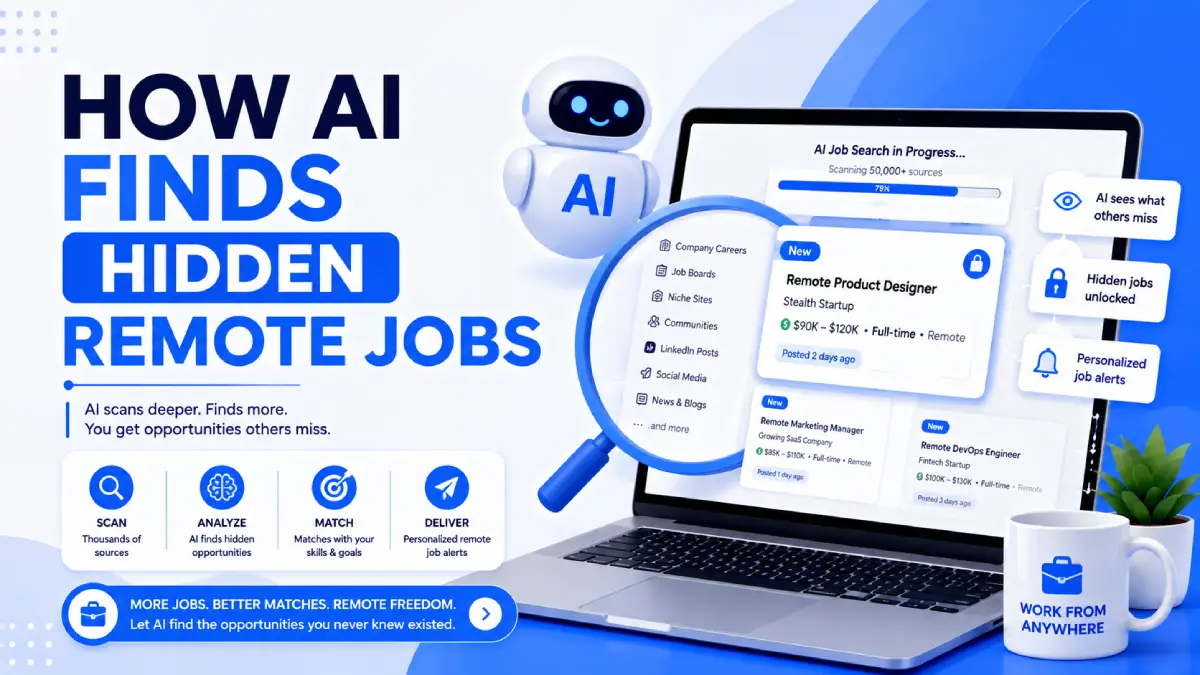
By the time a remote role reaches a job board, a few hundred people have already seen it. The useful window opens earlier, when a company closes funding, enters a new market, or a team lead starts quietly asking their network who is any good.
AI will not find those roles for you. What it does well is the research around them: tracking signals across many companies at once, working out who to approach, and keeping follow ups organised. The five step system below covers that, and is straight about what a hiring signal does not tell you.
AI can help you research companies, identify hiring signals, organize prospects, find the people closest to a business problem, personalize outreach, and keep track of follow-ups. It cannot guarantee that a company is hiring, but it can help you spot opportunities earlier and approach companies with more context.
The five-step system below covers finding hidden remote jobs before they surface on the usual boards, and is explicit about what each step can and cannot tell you.
1. Pick 30 Remote First Companies
The first step is to stop searching for every possible company.
Create a focused list of around 30 companies that genuinely fit your career goals.
Look for companies based on:
- Your professional skills
- Industry experience
- Products you understand
- Remote work policies
- Countries where they hire
- Salary expectations
- Company size
- Type of role you want
- Career growth opportunities
For example, if you are a digital marketer, your list might include remote-first SaaS companies, AI startups, marketing platforms, e-commerce businesses, and technology companies that could benefit from SEO or content expertise.

The goal is quality rather than creating a huge database of random companies.
Build a Remote Job Tracker
You can use Google Sheets or Notion to create your own prospecting system.
| Tracker Column | What to Record |
|---|---|
| Company | Company name |
| Website | Official company website |
| Role Type | Job or service you could provide |
| Remote Policy | Fully remote, hybrid, location-specific |
| Country | Relevant hiring location |
| Hiring Signal | Funding, launch, expansion, new team |
| Contact Person | Relevant decision-maker |
| Message Status | Not contacted, sent, replied |
| Next Action | Follow-up or research task |
| Notes | Important company information |
This turns your remote job search into a manageable pipeline instead of a collection of browser tabs.
2. Track Hiring Signals With AI
Once you have your 30 companies, start researching what is happening inside them.
You can use AI research tools, search engines, and company websites to investigate potential signals.
Useful searches include:
company name + fundingcompany name + product launchcompany name + expansioncompany name + remote hiringcompany name + new teamcompany name + hiring manager
You can also search for recent announcements, leadership changes, new markets, partnerships, and major product updates.
What Hiring Signals Should You Look For?
The important thing is not to treat these events as guaranteed job openings.
Instead, use them as clues worth investigating.
| Signal | Why It May Matter |
|---|---|
| Fresh funding | The company may have additional resources for growth |
| New product | New products can create additional operational needs |
| Market expansion | Expansion can require new sales, marketing, support, or operations capacity |
| New team | A growing team can indicate organizational expansion |
| Major partnership | New partnerships may create additional workload |
| Leadership change | New leaders sometimes bring new priorities |
| Product growth | Increased demand can create pressure to expand teams |
For example, imagine an AI company announces a new product for small businesses.
You are a content marketer with experience writing about AI and SaaS.
Instead of waiting for that company to publish a content marketing position, you can research the product launch, understand its audience, identify the marketing leader, and start a relevant conversation.
That is the basic idea behind finding hidden remote jobs.
3. Find the Person With the Problem
This is one of the most important steps.
Finding a company is not enough. You need to identify the person closest to the business problem you could help solve.
Depending on your target role, look for people such as:
- Founder
- Team lead
- Head of department
- Product lead
- Marketing lead
- Sales lead
- Operations lead
- Hiring manager
For example:
New product launched: Look toward the product, marketing, or growth team.
New market announced: Look toward sales, growth, or regional operations.
Company recently expanded: Look toward the department experiencing that growth.
New marketing initiative: Look toward the marketing leader or content team.
Why Start With the Team?
A public job listing is usually a formal recruiting process.
But the underlying business problem can exist before the listing.
A marketing leader may already realize that the team needs more content. A sales leader may know that expansion requires more sales capacity. A product manager may know that a new product needs additional support.
That does not mean you should ignore recruiters or HR. It means your initial research can focus on understanding the team and its needs rather than immediately asking for a vacancy.
4. Give AI the Context Before Writing Your Message
One of the easiest ways to make outreach sound generic is to ask AI:
“Write me a message asking for a remote job.”
Instead, give AI the information it needs.
Include:
- Company signal
- Person’s role
- Your target role
- Your strongest relevant experience
- Why you are interested in the company
- One specific observation
- Desired tone
- A clear restriction against sounding like a job request
A Useful AI Prompt
Write a short professional message based on the following context.
Company signal: [describe the recent development]
Person’s role: [role]
My experience: [strongest relevant proof]
Why I care about the company: [specific reason]
Connect the company signal to my experience.
Do not directly ask for a job.
Ask one thoughtful question that can start a conversation.
Keep the message natural, specific, friendly, and under 600 characters.
The purpose is not to convince someone to hire you immediately.
The first objective is to create a relevant conversation.
Avoid the Generic Job Request
Avoid messages like:
“Hi, are you hiring?”
Or:
“I’m looking for a remote job. Please let me know if you have any opportunities.”
These messages provide little context and put all the work on the recipient.
Instead, explain why you reached out.
For example:
“I saw your team recently launched [product]. I’ve spent the last few years creating content for SaaS products, and the launch caught my attention. I’m curious, how are you planning to scale content around the new product?”
That message creates room for an actual conversation.
5. Automate Your Follow Up Without Spamming
Finding a promising company is only half the process.
The other half is remembering what you did next.
This is where automation can help.
You can connect Google Sheets with Zapier to create workflows around your tracker. Zapier currently supports Google Sheets triggers and actions, including workflows based on new or updated spreadsheet rows.
For example, your workflow could be:
New company added → create follow-up reminder → track contact → update response status
You could create a simple five-day follow-up reminder after sending an initial message.
Suggested Status System
| Status | Meaning |
|---|---|
| Not Contacted | Research is complete but outreach has not started |
| Message Sent | Initial message has been sent |
| Replied | Contact responded |
| Follow Up Needed | No response or another action is required |
| Not a Fit | Opportunity is no longer relevant |
| Warm Lead | Conversation shows genuine potential |
Automation should reduce administrative work, not turn your outreach into spam.
Keep messages personalized and give people space to respond.
A Complete AI Workflow for Finding Hidden Remote Jobs
The entire process can be simplified into one repeatable workflow.
Step 1: Build Your List
Choose 30 remote-first companies that match your skills, industry interests, location requirements, and salary expectations.
Step 2: Research Each Company
Use search engines and AI research tools to identify recent developments.
Search for:
- Funding
- Product launches
- Expansion
- New teams
- Remote hiring
- Partnerships
- Leadership changes
Step 3: Record the Strongest Signal
Don’t save every piece of information.
Add the most relevant signal to your tracker and explain why it matters.
Step 4: Identify the Right Person
Find the founder, department head, team lead, product leader, marketing leader, sales leader, or another person connected to the problem.
Sabir’s take
I want to be straight about what this method does not do. It produces fewer applications, takes longer per application, and a hiring signal is a reason to start a conversation rather than proof of a vacancy. If you need work this month, keep applying to public listings alongside it. Over a longer horizon it changes who you end up talking to.
Frequently Asked Questions About Hidden Remote Jobs
What are hidden remote jobs?
Hidden remote jobs are potential opportunities that may not yet be publicly advertised as job listings. They can sometimes be identified through company growth, product launches, expansion, team development, or other business signals.
Can AI really find remote jobs before they are posted?
AI cannot reliably know that an unannounced job will be created. However, it can help you research companies, identify public hiring signals, organize information, and find relevant people to contact before a traditional job listing becomes available.
What companies should I target?
What This Approach Does Not Do
This method takes longer per application and produces far fewer of them. That is the trade. If you need work this month, keep applying to public listings alongside it.
The signals deserve honesty too. Funding does not mean hiring, and a product launch does not mean an open role. What a signal buys you is a reason to start a conversation slightly earlier than everybody else, not advance knowledge of a vacancy.
- Choose 30 remote-first companies.
- Track meaningful hiring signals.
- Find the person closest to the problem.
- Use AI to prepare a personalized message.
- Track and follow up consistently.
Once a conversation does turn into an application, tailoring the resume to that specific role is the next step.
Once a conversation becomes an application, tailoring the resume to that role is the next step, and a portfolio project gives a thin CV something to point at.