




Artificial Intelligence is transforming industries faster than ever before. Are you an MTech student looking for a research-worthy AI project that stands out in academic evaluations and industry interviews? Do you want to build something beyond basic chatbots and image classifiers?
If yes, this guide is exactly what you need.
In this article, we explore the best AI Projects for MTech Students in 2026 that combine innovation, practical applications, and research opportunities. These project ideas are suitable for dissertations, thesis work, conference papers, portfolio building, and industry placements.
Students can leverage modern AI models through platforms such as AIToolsay, which provides access to leading AI technologies from OpenAI, Google, Anthropic, Meta, NVIDIA, DeepSeek, Qwen, Grok, OpenRouter, MiniMax, and more.
Explore the platform here: aitoolsay.com
Why AI Projects Matter for MTech Students in 2026
The demand for advanced AI professionals continues to increase across healthcare, cybersecurity, finance, education, manufacturing, and autonomous systems.
A strong AI project helps students:
- Gain hands-on experience with modern AI technologies
- Publish research papers
- Improve placement opportunities
- Develop real-world problem-solving skills
- Build an impressive technical portfolio
- Explore emerging AI research areas
Unlike undergraduate projects, AI Projects for MTech Students should demonstrate deeper technical implementation, experimentation, model optimization, and innovation.
What Makes a Good MTech AI Project?
Before selecting a project, ensure it satisfies the following criteria:
| Factor | Importance |
|---|---|
| Research Potential | High |
| Industry Relevance | High |
| Innovation | High |
| Scalability | Medium |
| Dataset Availability | High |
| Publication Opportunity | High |
| Technical Complexity | High |
The best advanced AI projects MTech students choose often solve real-world challenges while introducing new methodologies or architectures.
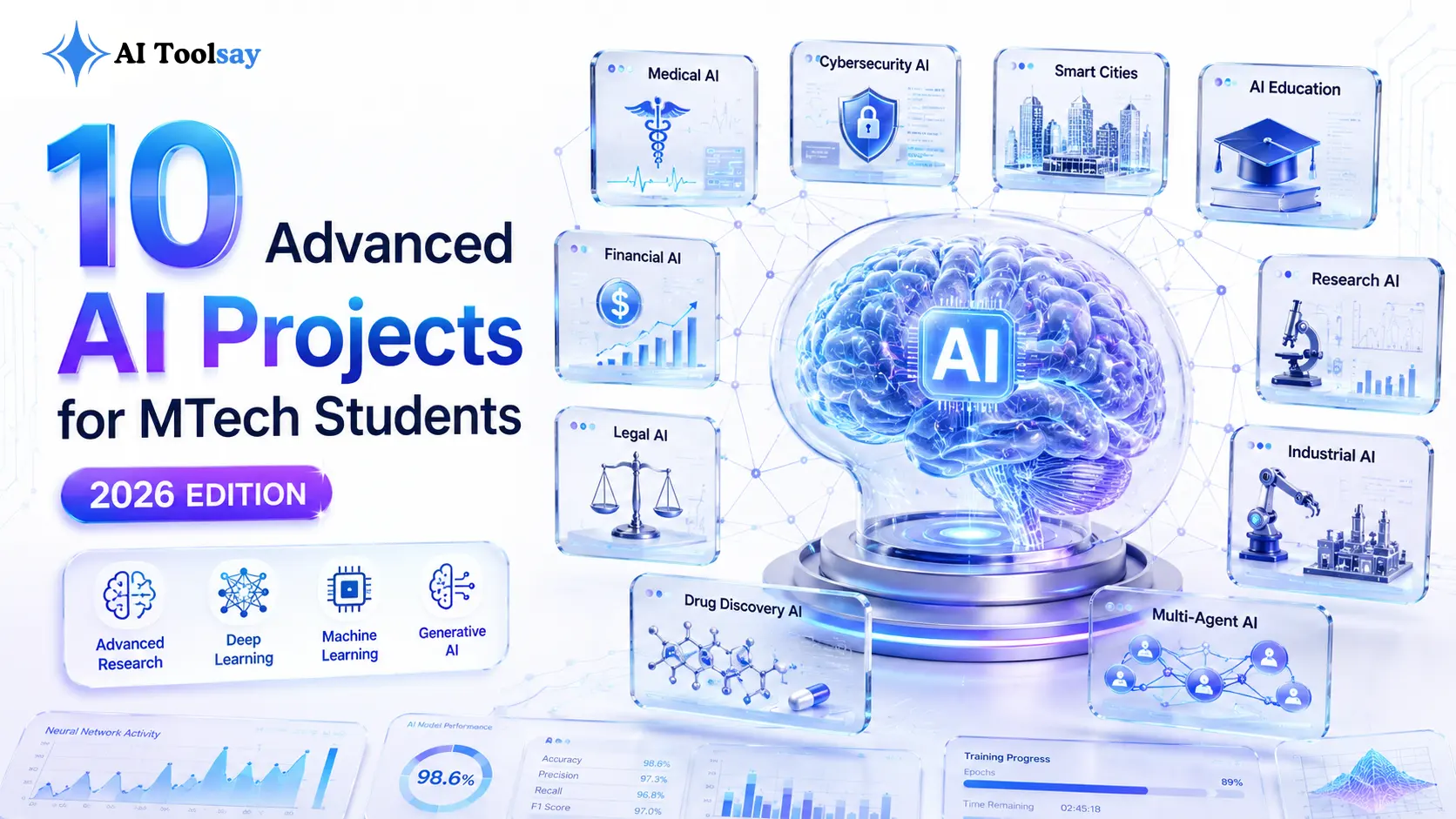
1. Multimodal Medical Diagnosis System Using Generative AI
Project Overview
Develop an AI system capable of analyzing multiple forms of medical information simultaneously, including:
- X-rays
- MRI scans
- CT scans
- Patient reports
- Laboratory results
- Doctor notes
The model combines computer vision and natural language processing to provide diagnostic recommendations.
Technologies
- Python
- PyTorch
- TensorFlow
- Vision Transformers
- Large Language Models
- Medical Image Processing
Research Opportunities
- Explainable AI in healthcare
- Multi-modal fusion architectures
- Clinical decision support systems
- Federated healthcare learning
Expected Outcome
A medical assistant capable of improving diagnostic accuracy while reducing physician workload.
AI Development Prompt
“Design a multimodal healthcare AI system capable of analyzing medical images, laboratory reports, electronic health records, and physician notes simultaneously. The architecture should combine computer vision models with advanced language models to generate explainable diagnostic recommendations. Include preprocessing pipelines, dataset requirements, model fusion strategies, evaluation metrics, deployment architecture, privacy considerations, and potential improvements. Allow customization for different diseases, imaging formats, hospital environments, and healthcare regulations.”
2. Autonomous Cybersecurity Threat Detection Platform
Project Overview
Cyberattacks are becoming increasingly sophisticated. Build an AI-powered cybersecurity platform capable of identifying threats in real time.
The system can analyze:
- Network traffic
- User behavior
- Access logs
- Malware signatures
- Insider threats
Technologies
- Deep Learning
- Graph Neural Networks
- Reinforcement Learning
- SIEM Integration
- Python
Research Opportunities
- Zero-day attack detection
- AI-driven threat hunting
- Adversarial machine learning
- Autonomous incident response
Expected Outcome
A self-learning security system capable of detecting previously unknown attack patterns.
AI Development Prompt
“Create an AI-based cybersecurity platform that continuously monitors enterprise networks for anomalies, malicious activity, insider threats, ransomware behavior, and advanced persistent threats. Generate a modular architecture including data ingestion, anomaly detection models, graph-based attack analysis, reinforcement learning agents, threat scoring mechanisms, and incident response workflows. Allow customization for organizational size, network complexity, compliance standards, security policies, and cloud infrastructure environments.”
3. AI-Powered Smart Traffic Management System
Project Overview
Urban congestion remains one of the biggest smart city challenges.
This project uses AI to:
- Predict traffic flow
- Optimize signal timing
- Detect accidents
- Reduce congestion
- Improve emergency vehicle routing
Technologies
- Computer Vision
- Reinforcement Learning
- Edge AI
- IoT Sensors
- Deep Neural Networks
Research Opportunities
- Smart city infrastructure
- Edge computing
- Vehicle behavior prediction
- Traffic optimization algorithms
Expected Outcome
An intelligent traffic system that adapts dynamically to road conditions.
AI Development Prompt
“Develop an intelligent traffic management platform that analyzes live traffic camera feeds, sensor data, GPS information, weather conditions, and historical transportation records. Design adaptive traffic signal optimization models, congestion prediction systems, emergency vehicle prioritization mechanisms, accident detection modules, and route recommendation engines. Include scalability options for different city sizes, transportation networks, sensor infrastructures, and smart city deployments.”
4. Personalized AI Tutor Using Large Language Models
Project Overview
Education is rapidly embracing personalized learning.
Build an AI tutor capable of:
- Understanding student weaknesses
- Generating personalized lessons
- Conducting assessments
- Providing adaptive feedback
- Tracking learning progress
Technologies
- Large Language Models
- Retrieval-Augmented Generation
- Knowledge Graphs
- Reinforcement Learning
Research Opportunities
- Adaptive learning systems
- Educational AI
- Learning analytics
- Student engagement prediction
Expected Outcome
A personalized education assistant that improves learning outcomes.
AI Development Prompt
“Design an AI tutor that delivers personalized learning experiences based on individual student goals, learning styles, academic performance, and knowledge gaps. Include curriculum generation, adaptive assessments, conversational tutoring, progress tracking, content recommendation engines, and learning analytics dashboards. Allow customization for educational levels, subjects, languages, institutional requirements, and accessibility standards while ensuring explainability and educational effectiveness.”
5. Explainable AI Framework for Financial Risk Prediction
Project Overview
Financial institutions increasingly rely on AI for lending and investment decisions.
This project focuses on creating transparent AI systems capable of predicting:
- Credit risk
- Loan defaults
- Fraud
- Market volatility
- Investment risk
Technologies
- Machine Learning
- Explainable AI
- SHAP
- LIME
- XGBoost
- Deep Neural Networks
Research Opportunities
- Trustworthy AI
- Financial transparency
- Regulatory compliance
- Bias reduction
Expected Outcome
A financial prediction system that provides both accurate forecasts and understandable explanations.
AI Development Prompt
“Develop an explainable financial risk prediction framework capable of assessing creditworthiness, fraud probability, loan default risks, and investment exposure. Include machine learning pipelines, feature engineering strategies, explainability modules, bias detection mechanisms, model monitoring systems, and regulatory compliance considerations. Allow adjustments for banking, insurance, investment management, fintech applications, and regional financial regulations.”
6. AI-Powered Legal Document Analysis and Case Prediction System
Project Overview
The legal industry generates massive amounts of structured and unstructured data. This project focuses on developing an AI system capable of analyzing legal documents and predicting case outcomes based on historical precedents.
The system can:
- Analyze court judgments
- Summarize legal documents
- Identify relevant precedents
- Predict case outcomes
- Generate legal insights
Technologies
- Natural Language Processing
- Large Language Models
- Legal Knowledge Graphs
- Transformer Models
- Retrieval-Augmented Generation
Research Opportunities
- Legal AI explainability
- Case outcome prediction
- Automated legal research
- AI-assisted judiciary systems
Expected Outcome
A legal intelligence platform that helps lawyers and researchers process complex legal information more efficiently.
AI Development Prompt
“Build an AI-powered legal analysis platform that processes court judgments, contracts, legal briefs, regulatory documents, and case histories. Design modules for document classification, legal entity extraction, precedent retrieval, case similarity analysis, judgment prediction, and explainable recommendations. Include support for multiple jurisdictions, legal domains, regulatory frameworks, document formats, and deployment environments while ensuring transparency and compliance with legal standards.”
7. Intelligent AI Research Assistant for Academic Literature Review
Project Overview
Researchers often spend weeks reviewing academic papers. This project develops an AI research assistant capable of automating large portions of the literature review process.
The system can:
- Search research papers
- Summarize findings
- Identify research gaps
- Compare methodologies
- Generate review reports
Technologies
- Natural Language Processing
- Vector Databases
- Retrieval-Augmented Generation
- Knowledge Graphs
- Large Language Models
Research Opportunities
- Scientific knowledge extraction
- Research gap detection
- Academic recommendation systems
- Automated review generation
Expected Outcome
An AI assistant that accelerates academic research and improves productivity.
AI Development Prompt
“Design an intelligent academic research assistant capable of analyzing scientific papers, conference proceedings, technical reports, patents, and scholarly databases. Include modules for semantic search, automatic summarization, citation analysis, research gap identification, methodology comparison, trend forecasting, and literature review generation. Allow customization for different research domains, publication databases, academic disciplines, and citation standards.”
8. AI-Based Predictive Maintenance System for Industry 4.0
Project Overview
Manufacturing industries increasingly rely on AI to prevent equipment failures before they occur.
The system can monitor:
- Machine sensors
- Temperature readings
- Vibration patterns
- Operational logs
- Equipment performance data
Technologies
- Machine Learning
- Time-Series Forecasting
- IoT
- Edge Computing
- Deep Learning
Research Opportunities
- Industrial AI
- Digital twins
- Predictive analytics
- Smart manufacturing
Expected Outcome
A predictive maintenance platform that reduces downtime and maintenance costs.
AI Development Prompt
“Create an industrial predictive maintenance system that continuously analyzes sensor streams, equipment logs, vibration signals, temperature measurements, operational histories, and production metrics. Design forecasting models, anomaly detection systems, failure prediction engines, maintenance scheduling modules, and digital twin integration frameworks. Include customization options for manufacturing plants, energy systems, transportation infrastructure, and industrial automation environments.”
9. Generative AI-Based Drug Discovery Platform
Project Overview
Drug discovery traditionally requires years of research and testing. AI is dramatically accelerating this process.
The project can:
- Generate molecular structures
- Predict drug interactions
- Simulate compounds
- Analyze biological targets
- Recommend candidate molecules
Technologies
- Generative AI
- Graph Neural Networks
- Deep Learning
- Bioinformatics
- Reinforcement Learning
Research Opportunities
- Computational biology
- Molecular generation
- AI-driven pharmaceutical research
- Protein structure prediction
Expected Outcome
A platform that assists pharmaceutical researchers in discovering potential drug candidates faster.
AI Development Prompt
“Develop a generative AI drug discovery platform capable of designing novel molecular structures, predicting biological activity, evaluating toxicity, simulating drug-target interactions, and prioritizing candidate compounds. Include graph neural network architectures, reinforcement learning optimization, molecular property prediction, explainability mechanisms, validation pipelines, and support for multiple therapeutic domains, biological targets, and pharmaceutical research workflows.”
10. Autonomous Multi-Agent AI Business Decision System
Project Overview
One of the most advanced AI Projects for MTech Students involves autonomous AI agents collaborating to solve complex business problems.
The system can:
- Analyze business data
- Forecast trends
- Recommend strategies
- Optimize operations
- Simulate decisions
Technologies
- Agentic AI
- Large Language Models
- Multi-Agent Systems
- Reinforcement Learning
- Knowledge Graphs
Research Opportunities
- Autonomous decision-making
- Multi-agent coordination
- AI governance
- Enterprise AI systems
Expected Outcome
A business intelligence platform capable of autonomous strategic planning and decision support.
AI Development Prompt
“Create a multi-agent AI business intelligence platform where specialized autonomous agents collaborate to analyze market trends, customer behavior, operational performance, financial metrics, and strategic objectives. Design agent communication protocols, planning frameworks, decision optimization models, forecasting engines, governance mechanisms, and explainable reporting systems. Allow customization for different industries, organizational structures, business objectives, and enterprise environments.”
Comparison Table of the Best AI Projects for MTech Students
| Project | Difficulty Level | Research Potential | Industry Demand |
|---|---|---|---|
| Medical Diagnosis System | Very High | Very High | Very High |
| Cybersecurity Threat Detection | Very High | High | Very High |
| Smart Traffic Management | High | High | High |
| Personalized AI Tutor | High | High | High |
| Financial Risk Prediction | High | High | Very High |
| Legal Analysis System | High | Medium | High |
| AI Research Assistant | High | Very High | High |
| Predictive Maintenance Platform | High | High | Very High |
| Drug Discovery Platform | Very High | Very High | Very High |
| Multi-Agent Business System | Very High | Very High | Very High |
How to Select the Right AI Project
When choosing among these AI Projects for MTech Students, consider:
Choose Healthcare AI If:
- You are interested in medical research.
- You plan to pursue a PhD.
- You enjoy computer vision applications.
Choose Cybersecurity AI If:
- You enjoy network security.
- You want strong industry demand.
- You like anomaly detection systems.
Choose Generative AI Projects If:
- You want to work with cutting-edge technologies.
- You are interested in foundation models.
- You plan to join AI startups or research labs.
Choose Industrial AI If:
- You prefer practical engineering applications.
- You enjoy IoT systems.
- You are interested in manufacturing automation.
Recommended Development Workflow
A successful implementation process typically includes:
- Problem Definition
- Literature Review
- Dataset Collection
- Data Preprocessing
- Model Selection
- Training and Optimization
- Evaluation and Validation
- Deployment
- Documentation
- Research Publication
Following this workflow improves the quality of advanced AI projects MTech students develop and increases publication potential.
Skills Required for Advanced AI Projects
Before starting any of these projects, students should be familiar with:
- Python Programming
- Machine Learning Fundamentals
- Deep Learning Frameworks
- Statistics and Probability
- Data Structures and Algorithms
- Cloud Computing
- Model Evaluation Techniques
- Research Methodology
Even if you are still learning, modern AI platforms can accelerate experimentation and prototyping.
Try advanced AI models and tools through AIToolsay: aitoolsay.com/ai-tools
Benefits of Working on Advanced AI Projects
Students who complete high-quality mtech artificial intelligence projects gain several advantages:
- Better research publication opportunities
- Stronger internship applications
- Industry-ready technical skills
- Exposure to cutting-edge AI frameworks
- Enhanced problem-solving capabilities
- Higher chances of securing AI-focused roles
For practical experimentation, students can use advanced AI models available through AIToolsay’s AI tools collection: aitoolsay.com/ai-tools
The platform provides access to multiple AI ecosystems from a single interface, making it useful for rapid prototyping and research validation.
Emerging Technologies Powering AI Projects in 2026
Several technologies are shaping the future of machine learning projects MTech students are building:
Large Language Models (LLMs)
Modern AI assistants, coding systems, and research agents rely heavily on LLMs for reasoning and content generation.
Multimodal AI
These systems process text, images, video, audio, and structured data simultaneously.
Agentic AI
Autonomous agents capable of planning, reasoning, and executing complex tasks are becoming a major research area.
Edge AI
Running AI models directly on devices reduces latency and improves privacy.
Explainable AI
Organizations increasingly require transparent and trustworthy AI decision-making systems.
These technologies create excellent opportunities for innovative deep learning project topics and advanced research work.
Frequently Asked Questions
What are the best AI Projects for MTech Students in 2026?
Some of the best projects include medical diagnosis systems, cybersecurity threat detection platforms, AI research assistants, predictive maintenance systems, drug discovery platforms, and multi-agent business intelligence systems.
Which AI project has the highest research potential?
Generative AI drug discovery, multimodal healthcare systems, and autonomous multi-agent AI platforms currently offer some of the highest research potential.
Are these projects suitable for thesis work?
Yes. All ten projects discussed in this article can be expanded into full MTech thesis projects with significant research contributions.
Which programming language is best for AI projects?
Python remains the most widely used language for AI development because of its extensive ecosystem, community support, and machine learning libraries.
Can beginners start these projects?
These projects are designed for MTech-level students. Beginners can start by learning machine learning fundamentals before moving to advanced implementations.
Which AI domain has the highest job demand?
Healthcare AI, cybersecurity AI, generative AI, industrial AI, and enterprise AI currently offer strong career opportunities worldwide.
Final Thoughts
The future of artificial intelligence belongs to professionals who can build innovative, research-driven solutions. The AI Projects for MTech Students covered in this guide represent some of the most impactful and future-ready opportunities available in 2026.
Whether your goal is publishing research papers, securing top placements, building a startup, or pursuing doctoral studies, selecting the right project can significantly influence your academic and professional journey.
Focus on solving real-world problems, explore emerging technologies such as multimodal AI and agentic systems, and continuously evaluate your models using rigorous research methodologies.
Thank you for reading this guide from AIToolsay. We invite you to join our growing AI community, explore powerful AI tools, subscribe to our newsletter, enable push notifications, and follow our social media channels to stay updated with the latest developments in artificial intelligence, machine learning, research innovations, and emerging technology trends.
Visit AIToolsay today: aitoolsay.com