




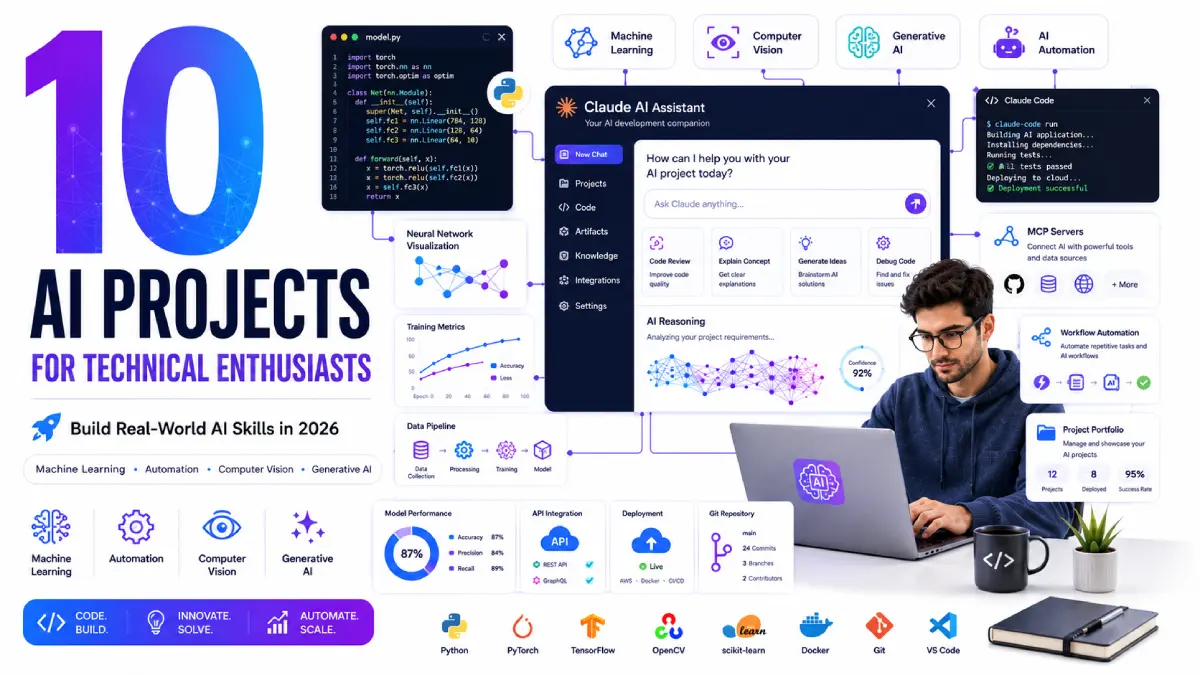
Artificial intelligence is no longer limited to research labs or large technology companies. Today, developers, engineering students, data scientists, and technology hobbyists can build powerful AI applications using accessible tools, open-source frameworks, and cloud platforms.
Are you looking for challenging AI projects that go beyond beginner tutorials? Do you want to create real-world applications that strengthen your portfolio and improve your practical AI skills? If yes, this guide is exactly what you need.
In this article, you’ll discover the best AI Projects for Technical Enthusiasts to build in 2026. These projects combine machine learning applications, generative AI, computer vision, natural language processing, and automation technologies. Whether you’re a student, software engineer, or AI hobbyist, these practical AI project ideas can help you gain valuable hands-on experience while building impressive portfolio projects.
If you’re looking for free AI tools, AI models, and productivity resources, explore AIToolsay, a platform offering access to leading AI technologies from OpenAI, Google Gemini, Claude AI, DeepSeek, Qwen, Grok AI, NVIDIA AI, OpenRouter AI, MiniMax, Meta AI, and more.
Why Build AI Projects in 2026?
The AI industry continues to evolve rapidly. Employers and clients increasingly value practical experience over theoretical knowledge alone.
Building artificial intelligence projects helps you:
- Apply machine learning concepts to real-world problems
- Improve software engineering skills
- Learn data preprocessing and model deployment
- Build a strong AI portfolio
- Understand AI product development workflows
- Gain experience with modern AI frameworks
- Prepare for technical interviews and research opportunities
The best way to master AI is by creating projects that solve actual problems.
Quick Overview of the Best AI Projects for Technical Enthusiasts
| Project | Difficulty | Technologies |
|---|---|---|
| AI Research Assistant | Intermediate | LLMs, RAG, Vector Databases |
| Smart Code Reviewer | Advanced | NLP, Code Models |
| AI Cybersecurity Monitor | Advanced | Anomaly Detection |
| Personal AI Knowledge Base | Intermediate | Embeddings, Search |
| AI Financial Insights Dashboard | Intermediate | Time Series Analysis |
| Computer Vision Defect Detector | Advanced | CNNs, Vision Models |
| Voice-Controlled AI Agent | Advanced | Speech Recognition |
| AI Resume Analyzer | Intermediate | NLP |
| AI Learning Companion | Intermediate | Generative AI |
| Multi-Agent AI Automation System | Advanced | Agent Frameworks |
1. AI Research Assistant
An AI Research Assistant is one of the most practical AI project ideas for technical enthusiasts. The system can read documents, answer questions, summarize research papers, and retrieve relevant information from large datasets.

Instead of manually searching through hundreds of documents, users can ask natural language questions and receive accurate responses.
Key Features
- PDF document ingestion
- Semantic search
- Research paper summarization
- Citation extraction
- Context-aware question answering
Recommended Tech Stack
- Python
- LangChain
- FAISS
- OpenAI API
- Gemini API
- PostgreSQL
Example Prompt
“Analyze the uploaded research papers and generate a comprehensive summary focused on methodology, datasets, evaluation metrics, limitations, future research opportunities, and key findings. Present comparisons between papers, identify recurring themes, highlight conflicting conclusions, and create a structured report that can help a technical researcher quickly understand the current state of the field and identify possible innovation opportunities.”
Learning Outcomes
- Retrieval-Augmented Generation (RAG)
- Vector databases
- Embedding models
- Prompt engineering
- AI system architecture
2. Smart Code Reviewer
Software development teams increasingly use AI to improve code quality. A Smart Code Reviewer can automatically inspect source code and provide suggestions related to security, performance, maintainability, and coding standards.
This project is ideal for enthusiasts interested in AI coding assistants.
Key Features
- Bug detection
- Security analysis
- Refactoring suggestions
- Complexity evaluation
- Automated documentation
Recommended Tech Stack
- Python
- Code Llama
- GitHub APIs
- OpenAI Models
- Static Analysis Tools
Example Prompt
“Review the provided source code as a senior software architect. Identify logical bugs, security vulnerabilities, performance bottlenecks, memory inefficiencies, scalability concerns, code duplication, naming inconsistencies, and maintainability issues. Suggest optimized alternatives with explanations, provide best-practice recommendations, and generate a prioritized improvement roadmap suitable for production-level deployment.”
Learning Outcomes
- NLP for code understanding
- Software engineering automation
- Security analysis
- AI-powered developer tools
3. AI Cybersecurity Threat Monitor
Cybersecurity remains one of the most exciting machine learning applications in 2026.
An AI Cybersecurity Threat Monitor can analyze logs, network traffic, and user behavior patterns to detect suspicious activities.
Key Features
- Intrusion detection
- Anomaly detection
- Threat classification
- Security alerts
- Dashboard reporting
Recommended Tech Stack
- Python
- Scikit-Learn
- TensorFlow
- ELK Stack
- Network Monitoring Tools
Example Prompt
“Analyze incoming security logs, user authentication events, endpoint activity records, and network traffic patterns. Detect abnormal behavior, classify potential threats based on severity levels, identify indicators of compromise, generate risk scores, explain reasoning behind detections, and recommend mitigation strategies that security analysts can immediately implement.”
Learning Outcomes
- Classification models
- Unsupervised learning
- Cybersecurity analytics
- Real-time AI systems
4. Personal AI Knowledge Base
Many professionals struggle to manage information spread across notes, documents, websites, and research resources.
A Personal AI Knowledge Base allows users to store and retrieve information using natural language conversations.
Key Features
- Knowledge storage
- Semantic retrieval
- Intelligent note summarization
- Personalized recommendations
- Multi-document search
Recommended Tech Stack
- Python
- ChromaDB
- LangChain
- OpenAI Embeddings
- Streamlit
Example Prompt
“Search all available personal notes, meeting transcripts, project documents, learning materials, and saved articles. Identify information relevant to the user’s question, summarize findings clearly, highlight key action items, connect related concepts across sources, and present insights in an organized format that improves decision-making and knowledge retention.”
Learning Outcomes
- Vector search
- Information retrieval
- Knowledge management systems
- Generative AI integration
5. AI Financial Insights Dashboard
Financial analytics provides excellent opportunities for hands-on AI learning.
This project uses machine learning models to analyze historical market data, identify trends, and generate intelligent financial insights.
Key Features
- Market trend analysis
- Forecasting models
- Risk assessment
- Data visualization
- Investment summaries
Recommended Tech Stack
- Python
- Pandas
- Prophet
- TensorFlow
- Plotly
Example Prompt
“Analyze historical financial datasets, market indicators, economic signals, and portfolio performance metrics. Generate forecasts, identify emerging trends, calculate potential risks, evaluate asset behavior, explain important market movements, and create actionable insights using data-driven reasoning suitable for investors, analysts, and financial researchers.”
Learning Outcomes
- Time series forecasting
- Data analytics
- Predictive modeling
- Visualization techniques
6. Computer Vision Defect Detection System
Manufacturing, quality assurance, and industrial automation increasingly rely on AI-powered inspection systems. A Computer Vision Defect Detection System can automatically identify defects in products using images or video streams.
This project demonstrates advanced computer vision skills and is highly valuable for technical portfolios.
Key Features
- Image classification
- Object detection
- Defect localization
- Real-time monitoring
- Quality control reporting
Recommended Tech Stack
- Python
- OpenCV
- YOLO
- PyTorch
- TensorFlow
Example Prompt
“Analyze the uploaded product images and identify manufacturing defects, surface abnormalities, dimensional inconsistencies, color variations, cracks, scratches, missing components, and quality deviations. Highlight defect locations visually, assign confidence scores, categorize issues by severity, and generate a detailed inspection report suitable for production quality control teams.”
Learning Outcomes
- Deep learning
- Computer vision pipelines
- Object detection
- Image processing
- Industrial AI applications
7. Voice-Controlled AI Agent
Voice interfaces continue to gain popularity across mobile apps, smart devices, and enterprise systems.
A Voice-Controlled AI Agent can listen to user commands, understand intent, perform actions, and provide spoken responses.
Key Features
- Speech recognition
- Natural language understanding
- Task execution
- Voice responses
- Multi-step workflows
Recommended Tech Stack
- Python
- Whisper
- OpenAI APIs
- SpeechT5
- FastAPI
Example Prompt
“Act as an intelligent voice assistant capable of understanding conversational requests, managing productivity tasks, answering technical questions, summarizing information, scheduling activities, controlling connected services, and maintaining context across multiple interactions. Provide concise responses while accurately interpreting user intent and adapting to conversational changes.”
Learning Outcomes
- Speech-to-text systems
- Natural language processing
- Conversational AI
- Voice user interfaces
- AI automation
8. AI Resume Analyzer and Career Advisor
Recruiters often review hundreds of resumes for a single position. An AI Resume Analyzer can evaluate resumes, identify strengths and weaknesses, and provide career recommendations.
This is one of the most practical artificial intelligence projects for students and aspiring professionals.
Key Features
- Resume parsing
- Skill extraction
- ATS optimization
- Job matching
- Career recommendations
Recommended Tech Stack
- Python
- SpaCy
- Transformers
- OpenAI API
- PostgreSQL
Example Prompt
“Analyze the uploaded resume against the target job description. Evaluate technical skills, certifications, project experience, achievements, formatting quality, keyword relevance, and applicant tracking system compatibility. Identify missing qualifications, recommend improvements, suggest stronger wording, and provide actionable guidance to increase interview opportunities.”
Learning Outcomes
- NLP pipelines
- Information extraction
- Recommendation systems
- Career-focused AI solutions
9. AI Learning Companion
Education remains one of the fastest-growing AI sectors.
An AI Learning Companion can act as a personalized tutor that adapts explanations based on user knowledge levels and learning goals.
Key Features
- Personalized tutoring
- Quiz generation
- Learning path recommendations
- Progress tracking
- Interactive explanations
Recommended Tech Stack
- Python
- LangChain
- OpenAI Models
- Streamlit
- Vector Databases
Example Prompt
“Act as a personalized AI tutor. Assess the learner’s current understanding, identify knowledge gaps, create customized learning plans, explain complex concepts using real-world examples, generate quizzes with varying difficulty levels, provide feedback on incorrect answers, and continuously adapt instruction methods to maximize long-term learning outcomes.”
Learning Outcomes
- Educational AI systems
- Adaptive learning algorithms
- Personalization engines
- Generative AI workflows
10. Multi-Agent AI Automation System
One of the most advanced AI Projects for Technical Enthusiasts in 2026 involves creating multiple AI agents that collaborate to complete complex tasks.
Different agents can specialize in planning, research, coding, analysis, and reporting.
Key Features
- Agent collaboration
- Task delegation
- Workflow automation
- Autonomous reasoning
- Multi-step execution
Recommended Tech Stack
- CrewAI
- AutoGen
- LangGraph
- Python
- OpenAI APIs
Example Prompt
“Create a collaborative AI workflow where specialized agents perform research, data collection, analysis, validation, documentation, and reporting tasks. Each agent should communicate findings, verify outputs from other agents, resolve conflicts through reasoning, maintain task context, and produce a final deliverable that meets defined quality standards.”
Learning Outcomes
- Agent-based AI systems
- Advanced prompt engineering
- Workflow orchestration
- Autonomous AI architectures
Comparison Table: Choosing the Right AI Project
| Project Type | Best For | Difficulty Level |
|---|---|---|
| AI Research Assistant | NLP Enthusiasts | Intermediate |
| Smart Code Reviewer | Developers | Advanced |
| Cybersecurity Monitor | Security Engineers | Advanced |
| AI Knowledge Base | Productivity Builders | Intermediate |
| Financial Insights Dashboard | Data Analysts | Intermediate |
| Defect Detection System | Computer Vision Learners | Advanced |
| Voice AI Agent | Conversational AI Builders | Advanced |
| Resume Analyzer | NLP Students | Intermediate |
| AI Learning Companion | EdTech Enthusiasts | Intermediate |
| Multi-Agent System | Advanced AI Developers | Advanced |
How to Select the Best AI Project
When choosing among these AI Projects for Technical Enthusiasts, consider:
Your Current Skill Level
Beginners should start with:
- AI Knowledge Base
- Resume Analyzer
- Learning Companion
Intermediate builders can focus on:
- Research Assistant
- Financial Dashboard
- Voice Agent
Advanced developers should consider:
- Cybersecurity Monitor
- Defect Detection System
- Multi-Agent AI Systems
Portfolio Goals
Choose projects that:
- Solve real-world problems
- Demonstrate technical depth
- Showcase multiple AI skills
- Include deployment experience
- Have measurable outcomes
Industry Interest
Match projects with your target industry:
- Finance → Financial Dashboard
- Education → Learning Companion
- Manufacturing → Defect Detection
- Cybersecurity → Threat Monitor
- Software Engineering → Smart Code Reviewer
Tools That Can Accelerate AI Development
Modern AI builders can significantly reduce development time using powerful AI platforms and tools.
AIToolsay provides access to multiple leading AI models through a single platform, making experimentation easier for developers, students, and researchers.
Useful categories include:
- AI Writing Tools
- AI Coding Tools
- AI SEO Tools
- AI Chat Tools
- AI Education Tools
- AI Productivity Tools
- AI Business Tools
To explore available AI solutions, visit the main platform: aitoolsay.com
If you want to start building immediately, try AI tools and models here: aitoolsay.com/ai-tools
Frequently Asked Questions
What are the best AI Projects for Technical Enthusiasts in 2026?
The best projects include AI Research Assistants, Smart Code Reviewers, Multi-Agent AI Systems, AI Learning Companions, Cybersecurity Threat Monitors, and Computer Vision Defect Detection applications.
Which AI project is best for portfolio building?
A Multi-Agent AI Automation System, AI Research Assistant, or Smart Code Reviewer can demonstrate advanced AI engineering skills and stand out in technical portfolios.
Are these machine learning projects suitable for students?
Yes. Many of these machine learning projects students build today can be scaled according to experience level. Beginners can start with AI Knowledge Bases or Resume Analyzers before progressing to more advanced systems.
What programming language is best for AI projects?
Python remains the most popular language because of its extensive ecosystem, including TensorFlow, PyTorch, Scikit-Learn, LangChain, and numerous machine learning libraries.
How can I learn AI faster through projects?
Focus on hands-on AI learning by building projects that solve real problems. Combine theory with implementation, deployment, testing, and continuous improvement.
Do AI portfolio projects help with jobs?
Yes. Employers often evaluate practical experience. Well-documented AI portfolio projects demonstrate problem-solving ability, technical knowledge, and implementation skills.
The demand for AI professionals continues to grow across industries, making this the perfect time to build meaningful projects that strengthen your expertise.
These 10 AI Projects for Technical Enthusiasts cover a wide range of technologies, including machine learning applications, natural language processing, computer vision, generative AI, voice interfaces, cybersecurity, and autonomous agent systems. By completing even a few of these projects, you’ll gain valuable real-world experience while creating impressive AI portfolio projects that showcase your capabilities.
Whether you’re exploring practical AI project ideas for learning, preparing for technical interviews, building a startup prototype, or expanding your professional portfolio, these projects offer an excellent pathway toward mastering artificial intelligence.
Thank you for reading this guide from AIToolsay. We invite you to join our growing community through social media, newsletters, and browser push notifications to receive the latest updates on AI tools, emerging technologies, project ideas, tutorials, and industry trends. Stay connected with AIToolsay and continue your journey into the future of artificial intelligence.