






Do you sometimes struggle to stay focused while studying? Are you looking for practical ways to improve learning, retention, and academic performance? The right Writing Prompts for Students can help build stronger study habits, improve self-reflection, and develop critical thinking skills.
Writing is more than an academic task. It is a learning tool that helps students organize ideas, understand concepts, identify weaknesses, and create effective study strategies. Whether you’re in high school, college, or pursuing self-directed learning, these prompts can help strengthen essential study skills.
In this guide, you’ll find 35 customizable writing prompts for students that can be adapted to different subjects, learning levels, and educational goals.
Students who want AI-powered assistance for writing, brainstorming, studying, and research can also explore AIToolsay at aitoolsay.com, a free platform offering access to leading AI models and educational tools.
Why Writing Prompts for Students Improve Study Skills
Writing encourages active learning. Instead of passively reading information, students engage with concepts and process them in their own words.
Benefits include:
- Better memory retention
- Improved comprehension
- Stronger critical thinking
- Enhanced problem-solving skills
- Greater self-awareness about learning habits
- Better academic writing abilities
- Improved organization and planning
These student learning prompts are designed to support both academic success and personal growth.
Quick Overview of Study Skills Developed Through Writing
| Study Skill | How Writing Helps |
|---|---|
| Time Management | Encourages planning and reflection |
| Note-Taking | Reinforces understanding |
| Critical Thinking | Promotes analysis and evaluation |
| Goal Setting | Clarifies priorities |
| Memory Retention | Strengthens recall |
| Self-Assessment | Identifies strengths and weaknesses |
| Academic Writing | Improves communication skills |
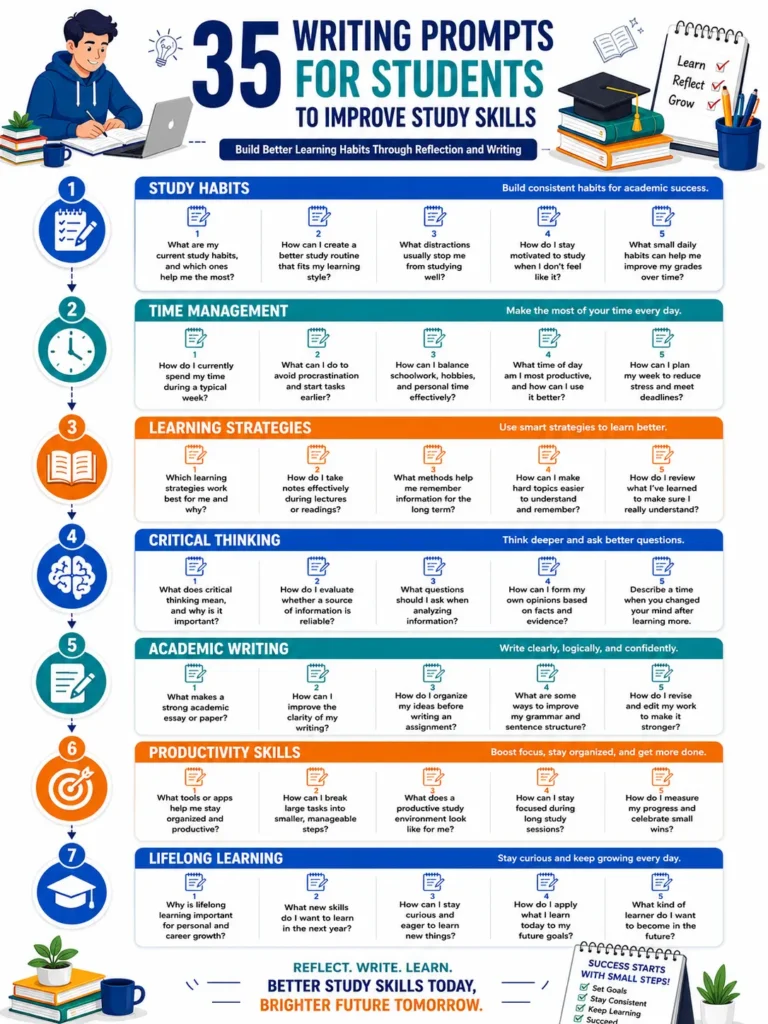
35 Writing Prompts for Students
1. Analyze Your Current Study Routine
Example AI Prompt:



Act as an academic coach and learning strategist. Analyze my current study routine in detail. I am a [grade/year/student type] studying [subject/course]. I typically study for [X] hours per day in [location]. I use [tools/apps/resources] and follow [study methods]. Identify at least 3 strengths and 3 weaknesses in my routine. Suggest practical improvements for productivity, focus, retention, and exam performance. Provide a step-by-step action plan I can implement immediately.
2. Design Your Ideal Study Environment
Example AI Prompt:
Act as a productivity expert and educational consultant. Help me design the ideal study environment based on my learning style. I am a [student type] who studies [subjects]. Consider factors such as lighting, noise levels, seating, technology, room organization, and study resources. Explain why each recommendation improves concentration and learning. Include separate recommendations for home study, library study, online learning, and group study sessions.
3. Reflect on a Successful Learning Experience
Example AI Prompt:
Act as a reflective learning coach. Help me analyze a successful learning experience where I mastered [subject/topic/skill]. Explain what study methods contributed to success, what challenges were overcome, and why the information was retained long-term. Identify lessons that can be applied to future learning situations. Create a framework that I can use to repeat similar academic success in other subjects.
4. Create a Weekly Study Improvement Plan
Example AI Prompt:
Act as a study planner and academic mentor. Create a detailed 7-day study improvement plan for me. My current academic goals are [goal]. I am studying [subjects] and can dedicate [hours] daily. Include daily objectives, focused study sessions, review periods, practice exercises, break schedules, and progress tracking methods. Make the plan realistic, balanced, and optimized for academic improvement.
5. Evaluate Your Time Management Skills
Example AI Prompt:
Act as a time management expert for students. Evaluate my current schedule and academic responsibilities. I spend approximately [hours] on classes, assignments, revision, extracurricular activities, and personal time. Identify time-wasting habits and productivity bottlenecks. Recommend practical strategies to improve scheduling, reduce distractions, and increase efficiency. Provide a revised weekly timetable and explain how it supports academic success.
6. Explain a Difficult Concept in Your Own Words
Example AI Prompt:
Act as an expert teacher who specializes in simplifying complex concepts. Explain [topic/concept] as if teaching it to a [middle school/high school/beginner] student. Use simple language, real-world examples, step-by-step explanations, and relatable analogies. Include common misconceptions, key takeaways, and a short summary. Make the explanation engaging and easy to remember.
7. Compare Two Study Techniques
Example AI Prompt:
Act as an educational psychologist. Compare [Study Method A] and [Study Method B] for learning [subject/topic]. Analyze their strengths, weaknesses, effectiveness for memory retention, exam preparation, understanding complex concepts, and long-term learning. Recommend which method would be best for different learning styles and academic goals. Include practical examples and situations where each technique works best.
8. Write About Your Biggest Academic Challenge
Example AI Prompt:
Act as an academic success coach. Help me analyze my biggest academic challenge, which is [describe challenge]. Explain possible causes, how it impacts learning and performance, and strategies to overcome it. Provide practical solutions, study techniques, productivity habits, and mindset changes that can help improve results. Create a personalized action plan for overcoming this challenge within the next 30 days.
9. Develop a Personalized Goal-Setting Strategy
Example AI Prompt:
Act as a goal-setting and academic planning expert. Help me create a personalized academic goal-setting strategy. My short-term goal is [goal], and my long-term goal is [goal]. Break each goal into actionable milestones, deadlines, and measurable outcomes. Identify potential obstacles and provide solutions. Include weekly progress checkpoints and motivational strategies to stay consistent throughout the learning journey.
10. Reflect on Your Note-Taking Habits
Example AI Prompt:
Act as a learning and note-taking specialist. Evaluate my current note-taking habits. I use [method/tool] during lectures, classes, or self-study sessions. Analyze the effectiveness of my approach for comprehension, memory retention, and exam preparation. Suggest improvements, alternative note-taking systems, digital tools, and organization methods. Provide examples of how an ideal note-taking process would look for my preferred learning style and academic subjects.
11. Explore the Impact of Technology on Learning
Example AI Prompt:
Act as an educational technology expert and learning strategist. Analyze how technology affects my educational experience. I regularly use [apps, websites, AI tools, online courses, educational platforms] for studying [subjects]. Discuss both the positive effects, such as accessibility, productivity, personalization, and collaboration, and the negative effects, such as distractions, information overload, and screen fatigue. Evaluate how technology supports or hinders my learning goals and provide recommendations for using digital tools more effectively while minimizing distractions.
12. Describe Your Exam Preparation Process
Example AI Prompt:
Act as an exam preparation coach. Help me analyze and improve my current exam preparation process for [subject/exam]. Explain how I should plan my study schedule, prioritize topics, revise effectively, practice questions, and track progress. Include stress management techniques, healthy study habits, and exam-day preparation strategies. Customize the advice based on my available study time, exam format, strengths, and weak areas. Provide a detailed step-by-step preparation framework.
13. Analyze a Learning Mistake
Example AI Prompt:
Act as a learning and self-improvement coach. Help me reflect on a learning mistake I made while studying [subject/topic]. Analyze what caused the mistake, how it affected my performance, and what lessons can be learned from the experience. Explain how I can prevent similar mistakes in the future through better study habits, planning, and decision-making. Create a personal improvement plan that turns this mistake into a valuable learning opportunity.
14. Create a Subject Mastery Roadmap
Example AI Prompt:
Act as a subject matter expert and academic mentor. Create a complete mastery roadmap for learning [subject]. My current skill level is [beginner/intermediate/advanced], and my goal is to achieve [specific objective]. Break the learning journey into milestones, weekly study plans, recommended resources, practical exercises, assessments, and progress checkpoints. Include estimated timelines and strategies for overcoming common learning obstacles. Make the roadmap realistic, measurable, and actionable.
15. Evaluate Your Reading Comprehension Skills
Example AI Prompt:
Act as a reading comprehension specialist. Evaluate my approach to reading academic materials such as textbooks, research papers, lecture notes, and study guides. Analyze how effectively I understand, retain, and apply information. Identify strengths and weaknesses in my reading process. Recommend strategies such as active reading, annotation, summarization, questioning techniques, and review methods. Create a personalized plan to improve my comprehension and long-term retention of academic content.
16. Reflect on Group Study Experiences
Example AI Prompt:
Act as a collaborative learning expert. Help me analyze my experiences with group study sessions. Discuss the benefits, challenges, communication dynamics, and learning outcomes of studying with others. Evaluate how group discussions, shared resources, peer teaching, and teamwork influenced my understanding of the subject. Recommend ways to make future group study sessions more productive and effective based on my learning goals and experiences.
17. Plan a Productive Study Week
Example AI Prompt:
Act as a student productivity coach. Create a detailed and realistic study plan for the next seven days. I am studying [subjects] and have [hours] available each day. Include study blocks, assignment deadlines, revision sessions, practice exercises, breaks, exercise, sleep, and wellness activities. Prioritize important tasks and explain how the schedule supports both academic success and personal well-being. Include methods for tracking progress and adjusting the plan if unexpected tasks arise.
18. Identify Your Learning Style
Example AI Prompt:
Act as an educational psychologist. Help me identify my primary learning style based on my study habits, academic experiences, and preferences. Analyze whether I learn best through visual materials, listening, reading and writing, hands-on activities, or a combination of approaches. Provide examples of effective study techniques for my learning style and explain how understanding my preferences can improve comprehension, retention, and academic performance.
19. Explore Motivation and Academic Success
Example AI Prompt:
Act as a motivation and performance coach. Analyze what motivates me to learn and achieve academic goals. Consider both internal motivations, such as personal growth and curiosity, and external motivations, such as grades, recognition, or career opportunities. Explain how motivation affects study habits, consistency, and performance. Provide practical strategies for maintaining motivation during difficult periods, overcoming procrastination, and staying committed to long-term educational goals.
20. Reflect on Academic Progress
Example AI Prompt:
Act as an academic advisor and reflection coach. Help me review my academic progress over the past [semester/year]. Analyze my achievements, challenges, study habits, skill development, and overall performance. Identify key lessons learned, areas where I improved, and aspects that still need attention. Based on this reflection, create a practical improvement plan with measurable goals, recommended study strategies, and action steps for future academic success.
21. Develop Better Concentration Strategies
Example AI Prompt:
Act as a focus and productivity coach for students. Help me identify the situations where I lose concentration while studying. My common distractions include [social media, notifications, noise, multitasking, procrastination, etc.]. Analyze the root causes of these distractions and explain how they affect my learning and productivity. Recommend practical concentration techniques, study routines, environment changes, and focus-building exercises that fit my learning style. Create a personalized action plan to improve focus and maintain productivity during study sessions.
22. Explain the Importance of Consistency
Example AI Prompt:
Act as an academic success mentor. Explain why consistency is one of the most important factors in academic achievement. Use practical examples to show how small daily study habits can lead to long-term success. Compare consistent studying with last-minute cramming and discuss the effects on retention, understanding, and performance. Help me build a realistic consistency plan based on my schedule, goals, and current study habits. Include methods for staying accountable and motivated over time.
23. Analyze a Research Project
Example AI Prompt:
Act as a research advisor and academic writing coach. Help me analyze a research project I completed on [topic]. Review the planning process, source selection, information gathering, organization, analysis, and final writing stages. Identify strengths and weaknesses in my approach. Explain what worked well, what challenges occurred, and what could be improved in future projects. Provide recommendations for conducting more effective, organized, and evidence-based research assignments.
24. Create a Study Resource Evaluation
Example AI Prompt:
Act as an educational consultant. Evaluate the study resources I regularly use, including [textbooks, online courses, YouTube videos, AI tools, study groups, educational websites, flashcards, apps, etc.]. Compare each resource based on reliability, accuracy, ease of use, engagement, and effectiveness for learning. Explain which resources are best for understanding concepts, exam preparation, skill development, and long-term retention. Recommend an ideal combination of resources based on my academic goals and learning style.
25. Explore Critical Thinking Skills
Example AI Prompt:
Act as a critical thinking instructor. Help me analyze a situation where critical thinking helped solve an academic problem in [subject/course]. Break down the reasoning process step-by-step, including how information was evaluated, assumptions were questioned, and conclusions were reached. Explain how critical thinking contributes to academic success and problem-solving. Provide practical exercises and strategies that can help me strengthen my analytical and decision-making skills.
26. Reflect on Academic Writing Development
Example AI Prompt:
Act as an academic writing mentor. Analyze how my writing skills have developed over time. Evaluate improvements in grammar, structure, clarity, argument development, research integration, and communication effectiveness. Discuss challenges I have faced and how they impacted my writing growth. Recommend strategies, exercises, and resources to continue improving my academic writing skills. Create a personalized development plan with short-term and long-term writing goals.
27. Build a Learning Improvement Strategy
Example AI Prompt:
Act as a learning strategist and academic coach. Create a comprehensive improvement strategy for helping me perform better in [subject/skill]. My current level is [beginner/intermediate/advanced], and my goal is [specific goal]. Develop a detailed plan that includes study resources, learning techniques, weekly schedules, progress tracking methods, practice activities, and measurable milestones. Include solutions for common challenges and explain how I can stay motivated throughout the improvement process.
28. Discuss the Value of Feedback
Example AI Prompt:
Act as an educational development expert. Help me analyze a time when feedback improved my academic work. Explain the nature of the feedback, how I responded to it, and the changes I made as a result. Discuss the importance of constructive criticism for personal and academic growth. Provide strategies for receiving feedback more effectively, applying recommendations, and using feedback as a tool for continuous improvement.
29. Evaluate Your Revision Methods
Example AI Prompt:
Act as an exam preparation and memory retention specialist. Evaluate my current revision methods, which include [flashcards, summaries, practice tests, mind maps, rereading notes, AI-assisted learning, etc.]. Analyze how effective each method is for understanding concepts, retaining information, and preparing for exams. Identify weaknesses in my revision strategy and recommend improvements. Create an optimized revision plan tailored to my subjects, exam schedule, and learning style.
30. Write About Lifelong Learning
Example AI Prompt:
Act as a lifelong learning and career development coach. Explain why continuous learning is important in today’s world. Discuss how strong study habits, curiosity, adaptability, and self-directed learning contribute to personal growth, professional success, and future opportunities. Help me connect my current academic efforts to long-term goals. Provide practical ways to develop a lifelong learning mindset and create a personal learning plan for ongoing growth beyond formal education.
31. Design a Study Skills Action Plan
Example AI Prompt:
Act as an academic success coach and study skills expert. Create a detailed 30-day action plan to improve my study habits and academic performance. My current challenges include [poor time management, procrastination, lack of focus, weak note-taking, inconsistent studying, etc.]. Include specific daily and weekly goals, study routines, productivity techniques, accountability systems, progress checkpoints, and methods for measuring improvement. Make the plan realistic, actionable, and tailored to my academic schedule, learning style, and educational goals.
32. Reflect on Productivity Habits
Example AI Prompt:
Act as a productivity and performance consultant for students. Help me analyze my daily habits and how they affect my academic success. Evaluate my routines related to studying, sleep, exercise, technology use, time management, and goal setting. Identify habits that support learning and habits that may reduce productivity or academic performance. Explain the impact of each habit and recommend practical changes that can help me become more focused, organized, and productive in my studies.
33. Explore Problem-Solving Techniques
Example AI Prompt:
Act as a critical thinking and problem-solving coach. Help me analyze a difficult academic problem I faced in [subject/course]. Describe the challenge, the steps I took to understand the issue, the solutions I considered, and the final outcome. Break down the reasoning and decision-making process. Explain what this experience taught me about perseverance, learning, and problem-solving. Provide additional techniques and frameworks I can use to solve similar academic challenges more effectively in the future.
34. Create a Self-Assessment Report
Example AI Prompt:
Act as an academic advisor and educational evaluator. Create a detailed self-assessment report based on my current academic performance. Analyze my strengths, weaknesses, study habits, learning skills, communication abilities, time management, and overall academic progress. Support the assessment with examples and evidence where possible. Identify opportunities for growth and provide specific recommendations for improvement. Include short-term and long-term action steps that can help me achieve greater academic success.
35. Imagine Your Future Academic Success
Example AI Prompt:
Act as an academic mentor and future success coach. Help me visualize my ideal academic future based on my goals of [degree, career, exam success, scholarship, skill mastery, etc.]. Describe what success looks like, the habits and mindset required to achieve it, and the obstacles I may need to overcome. Explain how discipline, effective study strategies, continuous learning, and personal growth contribute to long-term achievement. Create a step-by-step roadmap that connects my current actions with my future academic aspirations and success.
How Students Can Use These Educational Writing Activities
To maximize the benefits of these educational writing activities, students should:
- Write consistently each week
- Focus on honest self-reflection
- Customize prompts to personal goals
- Review previous responses regularly
- Identify patterns and opportunities for improvement
- Use writing as a learning and planning tool
These study skills writing exercises become even more effective when combined with regular revision and active learning techniques.
Using AI Tools to Enhance Student Writing
Modern AI tools can support brainstorming, outlining, grammar checking, and content organization. Students can use platforms like AIToolsay’s AI Writing Tools category at https://aitoolsay.com/category/ai-writing-tools to generate ideas, improve writing quality, and strengthen academic productivity while maintaining originality and critical thinking.
Frequently Asked Questions
What are writing prompts for students?
Writing prompts for students are guided questions or scenarios designed to encourage reflection, creativity, critical thinking, and academic skill development through structured writing exercises.
How do writing prompts improve study skills?
Writing prompts encourage active engagement with learning materials, helping students improve memory retention, organization, comprehension, and self-assessment abilities.
How often should students use writing prompts?
Students can benefit from using writing prompts several times per week. Consistent practice supports long-term improvement in study habits and academic performance.
Can writing prompts be customized?
Yes. Each prompt can be adjusted according to age, grade level, subject area, academic goals, or personal learning challenges.
Are writing prompts useful for college students?
Absolutely. College students can use these academic writing prompts to strengthen research skills, time management, critical thinking, and academic communication.
Can AI help students complete writing exercises?
AI can assist with brainstorming, outlining, editing, and organization. However, students should always use their own critical thinking and understanding when completing educational assignments.
Final Thoughts
Strong study habits are not developed overnight. They grow through consistent reflection, practice, and continuous improvement. These Writing Prompts for Students provide a practical framework for developing better learning strategies, improving academic performance, and building lifelong educational skills.
Whether you’re working on Student Writing, strengthening Study Skills, improving Academic Writing, or exploring new Learning Resources, these prompts can help you become a more confident and effective learner.
Thank you for reading. Stay connected with AIToolsay for more educational resources, AI-powered learning tools, and productivity solutions. Join our community through social media, push notifications, and newsletters to receive the latest updates, learning tips, and AI innovations that can support your academic journey.