 English

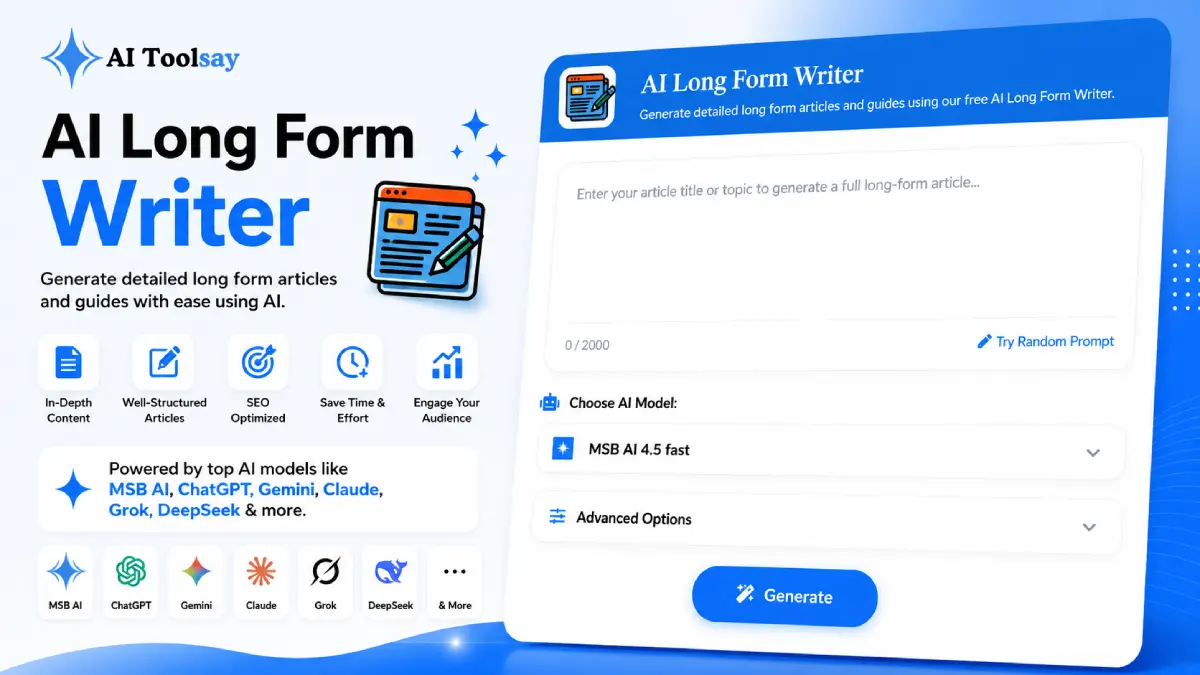
AI Long Form Writer
Generate detailed long form articles and guides using our free AI Long Form Writer.
 MSB AI 4.5 fast








Your article title will appear here…
Your beautifully formatted article will appear here once you generate.
No history yet
Your generations will appear here. Sign in to save them permanently.





You have probably been told that nobody reads long articles anymore, that attention spans have collapsed and the future belongs to the quick and the skimmable. I want to gently push back on that. People do not avoid long content. They avoid boring, padded, poorly organised content, and they leave short pieces just as fast when those pieces fail to answer the question. What holds a reader is not brevity. It is completeness, arranged well, so that every follow up question they had is waiting for them a paragraph later.
That is the belief I keep bumping into, and it is why I built and lean on the AI Long Form Writer. You give it a topic, choose the format and the length, and it hands back a full, structured article in seconds. It is free to use, and you can pick from several premium models when you want the strongest draft.
Quick Answer: The AI Long Form Writer is a free AIToolsay tool that turns a topic or title into a complete long form article. You set the intent, audience, content type, tone, style, length, readability, paragraph length, opening hook, and ending, then generate a thorough draft you can polish and publish.
Why Length Loses Its Bad Reputation When the Structure Is Right
Think about the last genuinely useful guide you read. Odds are it was not three sentences. It walked you from confusion to clarity, and it kept going until you had what you came for. That is the honest case for depth. A person researching how to price a service does not want a slogan. They want the models, the math, the common mistakes, and a way to decide. Give them all of that on one page and their search ends. Give them a fraction and they bounce back to the results and find the rest somewhere else.
Every one of those bounces is a small message to a search engine that your page was not quite enough. Over months, those messages add up and quietly settle where you rank. So the goal was never to write long for its own sake. The goal is to be the last click, the page that leaves nothing unanswered. Long form is simply what that often looks like once you cover the topic honestly. The trap people fall into is padding, stretching a thin idea to hit a word count, and readers feel that instantly. Depth with structure earns trust. Length without substance burns it. I have watched thin two hundred word posts outperform bloated two thousand word ones, and the reason was never the count. The short post answered its one narrow question cleanly, while the long one buried a small idea under filler. So the honest rule is simple. Match the length to the size of the question, then cover that question so completely that no one needs a second tab open.
What I like about generating the draft first is that the shape arrives before the fatigue does. You are not staring at an empty page at word three hundred, wondering how to reach three thousand. The skeleton is there. Your energy goes into sharpening, correcting, and adding the parts only you can bring.
There is also a quieter benefit that took me a while to appreciate. When a full draft exists, editing feels achievable in a way that writing from nothing never does. Cutting a weak sentence is easy. Tightening a loose paragraph is easy. Rearranging a section that landed in the wrong place is easy. Producing all of that raw material from scratch, on a tired afternoon, is the part that stops most people before they begin. Remove that first hurdle and the whole task changes character. You stop dreading the article and start improving it, which is a much better place to work from and a much better mood to publish in.
Every Dial You Get to Turn Before You Generate
The reason the output feels finished rather than generic is the number of decisions you make up front. You are not typing a prompt and hoping. You are briefing the piece the way you would brief a writer, and each choice narrows the result toward what you actually need.
Eight Formats
Choose a guide, tutorial, in depth article, case study, research piece, evergreen post, pillar page, or SEO article.
Length You Set
Scale from a single tight topic up to several thousand words of full coverage when the subject earns it.
Five Reading Levels
Move from plain and beginner friendly to precise and expert, matched to who is actually reading.
Hook and Ending
Pick how the piece opens and how it closes so the first and last impressions are chosen, not accidental.
Beyond those, you control intent, audience, tone, style, readability, and paragraph length. Intent is the one people skip and later regret, because a piece meant to inform reads very differently from one meant to persuade or to sell, and the tool honours that difference once you name it. Short paragraphs suit a mobile reader skimming on a phone. Longer ones suit a considered piece meant for a desktop and a coffee. And because the tool writes in several languages while respecting the writing conventions of each, you can serve an audience that does not read in English without switching tools. None of these settings is decoration. Each one moves the draft a little closer to sounding like it came from you.
What Makes It Worth Opening
- Drafts that scale from a focused post to a cornerstone guide
- Reading levels that fit a beginner or an expert audience
- Deliberate control over the opening hook and the ending
- Free access to premium models with no subscription wall
Where Your Hand Still Matters
- Add original data, examples, and a point of view
- Check any claim or figure before it goes live
- Give long drafts one calm editing pass for flow
Briefing It Well So the Draft Actually Lands
The settings do the heavy structural lifting, which means your real work sits at two ends: the brief you give before, and the edit you give after. Get the brief specific and the whole draft tightens around it.
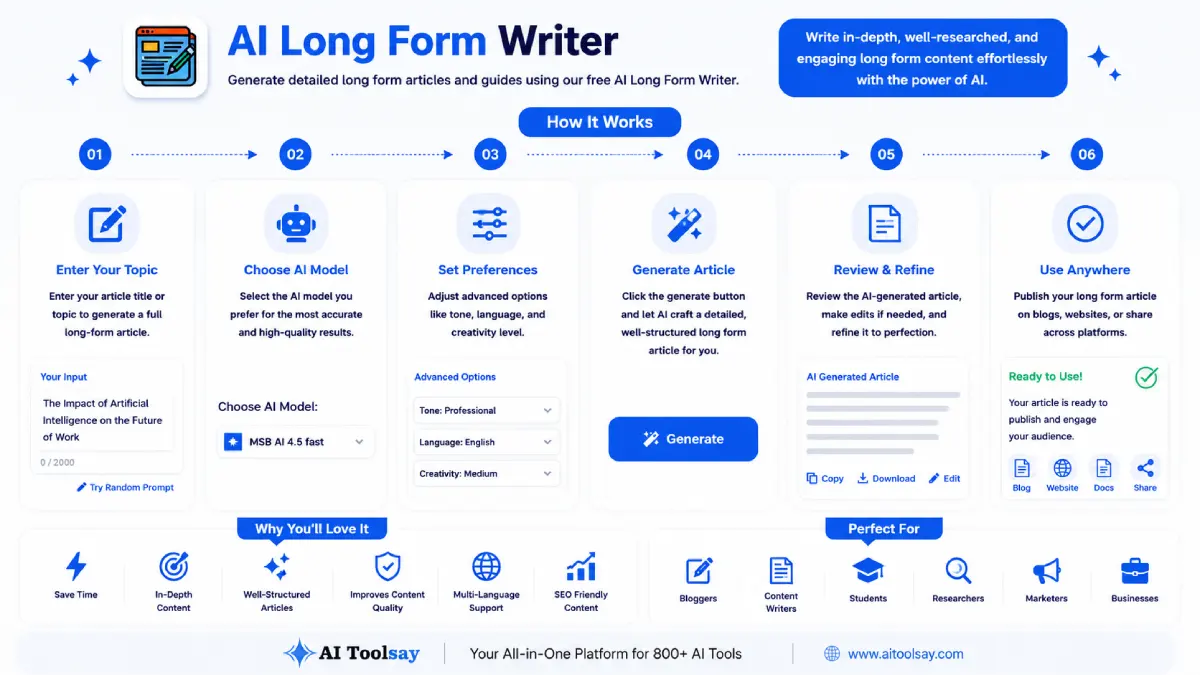
- Write a precise title. A vague title produces a wandering article. A specific one keeps every section on target.
- Set the intent and format. These tell the tool what the piece is for and how it should be shaped.
- Match the length to the audience level. Depth and reading level should agree, or the piece feels off.
- Choose the hook and the ending on purpose. They frame everything the reader remembers.
The hook choices are worth dwelling on. A statistic opening leads with a number that proves the subject matters. A problem opening names the frustration your reader already feels, so they see themselves in the first line. Endings work the same way. A call to action ending nudges a reader toward a next step, a forward looking ending positions you as someone thinking ahead, and a question ending invites the comments that turn a page into a small community. Picking these deliberately is the difference between an article that starts strong and finishes flat, and one that earns attention at both ends. Most writers leave both to chance and wonder why readers drift off halfway. Choosing them on purpose costs you two clicks and changes how the whole piece is received.
Pro Tip: For a pillar piece, generate at the three to five thousand word range, then layer in a table of contents, a couple of real figures with sources, and one short reflection in your own voice. Those human touches are what push a solid draft into the kind of resource other sites decide to link to.
Getting Sharper Results From Every Draft You Generate
Once you have used the tool a few times, the questions shift from how it works to how to squeeze the best possible piece out of it. That is usually the moment output quality really jumps, because you stop treating the draft as a finished thing and start treating it as raw clay. The generated text is a starting position, strong and structured, but it becomes something readers remember only after you have made a few deliberate choices about depth, voice, and proof. These are the questions I hear most, and the answers reflect how I actually use the tool week to week rather than any theory.
How do I get output that does not sound generic?
Specificity in equals character out. A precise title, a clear audience, a defined tone, and a chosen hook give the model real constraints to write toward. After that, add one thing no model can supply, your own example or lived observation, and the piece stops sounding like anyone could have written it.
Which length should I pick for a topic I want to rank?
Let coverage decide, not a number. A single angle done well can live comfortably around a couple thousand words. A subject with many sub questions, the kind you want to be the definitive answer for, is where the three to five thousand word range earns its keep. Pick the length that lets you answer every reasonable follow up and stop there.
How should I use the hook and ending settings together?
Treat them as a matched pair. A problem hook that opens on a pain point pairs naturally with a call to action ending that offers relief. A statistic hook pairs well with a forward looking close that projects where the trend goes next. Choosing both with the same reader in mind makes the article feel intentional from first line to last.
What is the fastest way to build a set of related articles?
Generate one pillar piece at the longest setting, then create several focused articles around its sub topics and link them back to it. In an afternoon you have the backbone of a content cluster that would normally take a week of drafting. The tool supplies the structure at speed, and your time goes into the data and voice that make it yours.
None of this asks much of you, and that is rather the point. You are busy, and a blank page is the slowest part of writing. Let the AI Long Form Writer carry the structure so your limited time lands where it counts, on the expertise and the honesty only you can add. Generate a draft, shape it for ten minutes, and publish something worth keeping.
.png)
Join the Newsletter
Get the best new AI tools and tips delivered to your inbox. No spam.
By subscribing you agree to receive emails from AIToolsay. Unsubscribe anytime.