
 English

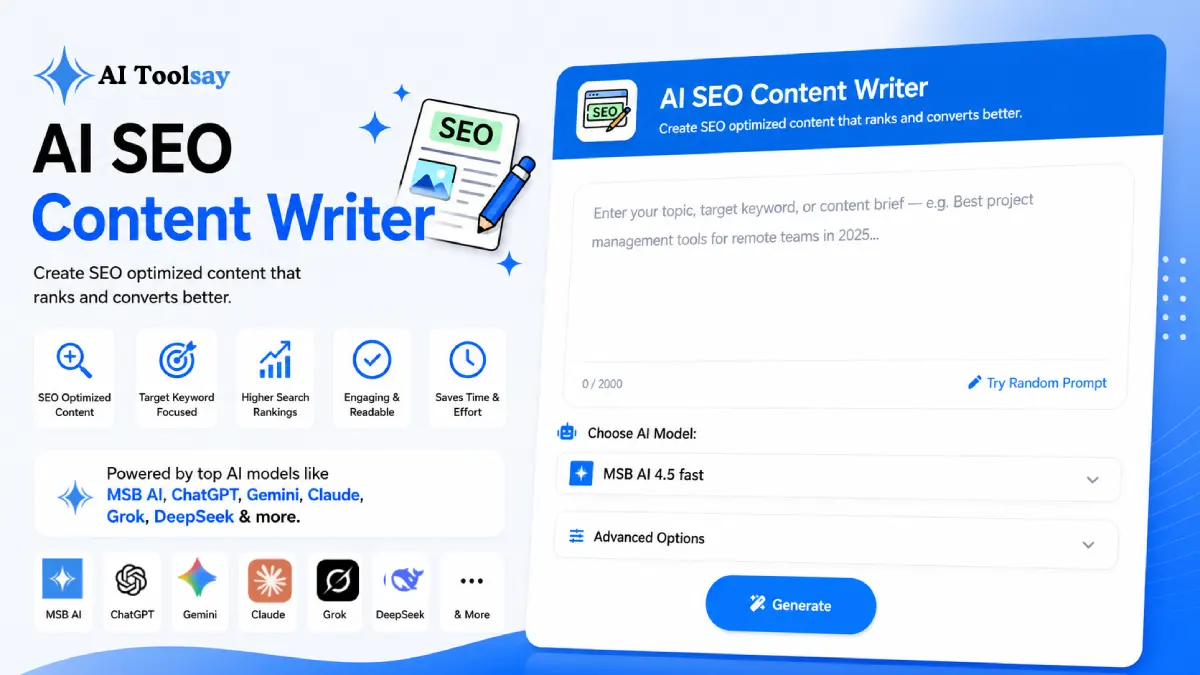
AI SEO Content Writer
Create SEO optimized content that ranks and converts better.
 MSB AI 4.5 fast








Your article title will appear here…
Your beautifully formatted article will appear here once you generate.
No history yet
Your generations will appear here. Sign in to save them permanently.





For years I wrote content backwards. I would pick a topic I liked, write a piece I was proud of, and then bolt a keyword onto the title and hope Google noticed. Some articles ranked. Most did not, and I could never explain why. It took me an embarrassingly long time to accept the real problem. I was answering the question I wanted to answer, not the one people were actually typing into search. Once that clicked, everything about how I plan a page changed, and the AI SEO Content Writer is the tool I now reach for to lock that thinking in before I write a single sentence.
The mistake was never my grammar or my ideas. It was structure and intent. A page that reads beautifully can still miss, because ranking is a matching game. The searcher has a goal, the top results already serve it, and your job is to serve it more completely and in the shape people expect. This tool builds that shape in from the start, which is exactly the discipline I lacked in those early years.
The Setting That Fixed My Ranking Problem
If I could go back and give my younger self one instruction, it would be this. Decide the search intent before you write anything. Intent is the reason behind the query, and the tool asks you to name it up front as informational, commercial, transactional, or navigational. That single choice reshapes the entire draft. An informational intent produces a teaching piece that explains and walks through. A commercial intent produces content built around weighing options. A transactional intent leans toward a decision and an action. Get this wrong and no amount of polish saves the page, because you are answering a different question than the one being asked.
I used to skip this step entirely, which is why my buying guides read like encyclopedia entries and my how to articles wandered into sales pitches. The intent setting stops that drift. It forces the honest question I never asked, which is what does this reader actually want to accomplish right now.
Quick Answer: The AI SEO Content Writer is a free AIToolsay tool that generates structured, search ready content in seconds. You give it a topic and target keyword, then set the search intent, audience, content type, writing style, tone, length, heading structure, and optimisation level, and it drafts a page shaped to match what searchers and search engines expect for that query.
Eight Formats, and Why the Right One Wins
Once intent is set, the content type does the next piece of heavy lifting. The tool offers eight formats, and each one carries its own conventions that readers recognise without thinking. You can generate a blog post, a landing page, a review, an affiliate piece, a tutorial, a comparison, a news article, or a listicle. These are not cosmetic labels. A comparison expects clear criteria and a verdict. A tutorial expects ordered steps. A listicle expects scannable, numbered value. When your format matches the reader's expectation, they settle in. When it fights the expectation, they bounce, and a fast bounce is one of the clearest signals that a page did not deliver.
What I appreciate is that intent and format have to agree with each other. A commercial query served as a plain blog post underperforms a comparison every time. The tool lets you pair them deliberately instead of guessing, and that pairing is where a lot of quiet ranking wins hide.
Three Reasons This Tool Earns a Place in My Workflow
I have tried plenty of generators that spit out fluent text and nothing else. Fluent text is cheap now. What I need is text that is already pointed at the search, and these three capabilities are why this one stays open in a tab while I work.
Intent First Drafting
You name the search goal before generation, so the whole structure lines up with what the reader came to do.
Four Optimisation Levels
Dial the keyword and coverage pressure from light to advanced depending on how competitive the topic is.
Heading Control
Pick clean H2 only, H2 plus H3, or a full structure so the hierarchy signals real depth.
Pairing Intent With the Format It Deserves
Because this is the part I got wrong for so long, it is worth laying out plainly. When someone asks me how to decide, I point them to a simple map. Read the query, name the intent, then pick a format that intent naturally rewards. The table below is close to the mental checklist I run before I generate anything.
| Search Intent | Formats That Fit | What the Reader Wants |
|---|---|---|
| Informational | Blog post, tutorial, news | To understand or learn how |
| Commercial | Review, comparison, affiliate | To weigh options before buying |
| Transactional | Landing page, review | To act, sign up, or purchase |
| Navigational | Landing page, blog post | To reach a specific brand or page |
The pattern is not rigid law, but it holds up more often than not. When I break it, I usually have a specific reason, and I can defend the choice. That is the difference between deliberate structure and the hopeful guessing I used to do.
How I Set It Up Before I Hit Generate
The tool is quick, but a little care in the setup produces a far stronger first draft. Here is the order I move through, and the image below shows where these controls live.
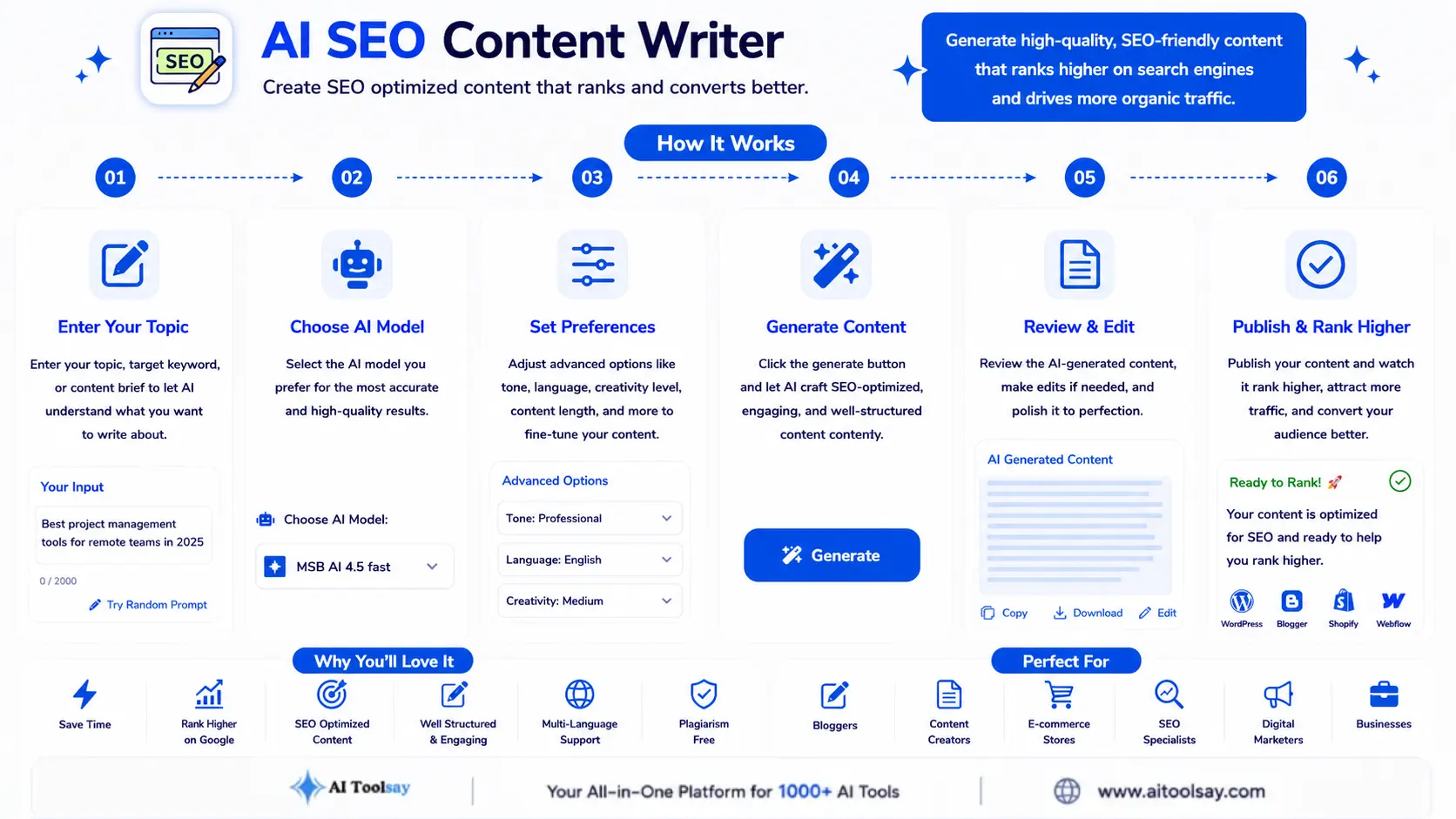
- Enter the topic and keyword. The keyword anchors the whole optimisation, so I make it specific rather than broad.
- Name the intent and content type. I match what already ranks for that exact query, not what I wish ranked.
- Set the audience, style, and tone. This is where the draft starts sounding like it belongs on my site instead of anywhere.
- Choose the length and heading structure. I aim to match or beat the depth of the current top results.
- Pick the optimisation level. Light for easy topics, advanced when the competition is fierce.
One habit that pays off every time. Before I generate, I open the top three pages for my keyword and note their length and how deep their headings go. Then I set my controls to meet or exceed that bar. The tool can calibrate to almost any target, but it cannot know the target unless you look first.
Why Depth and Language Reach Decide the Winner
Headings are more than tidy signposts. They are a map of how thoroughly a page covers its subject. A clear hierarchy that names the main topic and its subtopics tells a search engine the page is a complete answer. A flat page that skips the obvious follow up questions reads as partial, even when the wording is fine. The full structure option builds the kind of hierarchy that strong pages use, with a section for each major aspect and supporting points underneath, so a reader rarely has to click back to search for the part you left out. When their journey ends on your page, that is the exact outcome ranking systems are built to reward.
There is a reach advantage too. The tool produces content in several languages, and it applies the search and writing conventions of each market rather than translating word for word. That matters because a market you have been ignoring is often far less crowded than your home language, and a genuinely native reading page can rank there with a fraction of the effort. I have watched a modest piece do quiet, steady traffic in a second language simply because almost no one bothered to serve that audience well.
The years I spent trying to outsmart search taught me the opposite lesson. You do not win by being clever. You win by being the clearest, most complete answer to a question someone already decided to ask.
Sabir Bepari, Founder of AIToolsay
Choosing the Right Setting for Your Situation
Most of the questions I get are not about whether the tool works. They are about which setting to pick in a specific spot. These are the decisions that come up most, answered the way I would answer them for a friend.
When should I choose commercial intent over informational?
Choose commercial when the searcher is comparing before spending, which shows up in queries with words like best, top, versus, or a year attached. Choose informational when they want to understand a concept or learn a method with no purchase in sight. If the query mixes both, lead with the intent that matches the money moment, since that is usually why the page exists.
Which content type fits a buying guide?
Pair commercial intent with the comparison or review format for a buying guide. Comparison works when you are ranking several options against clear criteria, while review works when one product is the focus. Both give readers the verdict they came for, which a plain blog post tends to bury.
How high should I set the optimisation level?
Match the level to the competition, not to your ambition. Light optimisation suits low competition or long tail keywords where over stuffing would read badly. Advanced suits crowded, high value terms where you genuinely need every coverage signal working. Pushing the level higher than the topic demands can make a page feel forced, so let the search results set the bar.
Which heading structure should I pick?
Use clean H2 only for short, focused pieces where a deep hierarchy would feel padded. Move to H2 plus H3 for standard articles with a few subtopics each. Choose the full structure for pillar pages and competitive guides where demonstrating complete coverage is the whole point of ranking.
How do I decide the length?
Let the top three ranking pages decide it for you. Note their word counts, then set your length to match or slightly exceed the strongest one while keeping the quality high. Longer is not automatically better, but falling well short of what already ranks is a reliable way to look thin by comparison.
Is the tool actually free to use?
Yes, it is free, and it includes access to several premium AI models without a subscription. You can switch models to suit the job and generate as many drafts as a project needs, which is why I treat it as a planning tool as much as a writing one.
Every search is a question, and the page that wins is simply the one that answers it most completely in the shape the reader expected, which is exactly what this tool is built to help you produce. Set your intent, match your format, and let the AI SEO Content Writer give you a draft that is already pointed at the people searching for what you offer.
.png)
Join the Newsletter
Get the best new AI tools and tips delivered to your inbox. No spam.
By subscribing you agree to receive emails from AIToolsay. Unsubscribe anytime.